
- 📈 The Rise of AI Homework Helper Tools in Modern Education
- 🎓 How Students Use AI Homework Helper in Real Life
- 🔍 What Is Gauthmath? An AI Homework Helper Overview
- ⚖️ First Impressions: Gauthmath as an AI Homework Helper
- 🧪 Real Testing: Gauthmath vs Dechecker AI Homework Helper
- 📐 Math Problem Solving Performance
- 📚 Multi-Subject Homework Support
- 🖼 Input Formats and User Experience
- 💰 Cost, Limits, and Accessibility
- 🔄 Daily Study Flow Comparison
- 🎯 Choosing the Right AI Homework Helper Based on Learning Needs
- 🧭 Final Verdict: Which AI Homework Helper Is Right for You?
Gauthmath Review: AI Homework Helper Features & Alternatives
Homework has changed.
Not long ago, students relied on textbooks, after-school tutoring, or late-night Google searches. Today, AI Homework Helper tools are quietly transforming how millions of learners solve problems, understand concepts, and complete assignments.
According to recent education technology reports, over 60% of middle school and university students now use some form of AI-powered study assistant at least once a week. What started as simple answer generators has evolved into intelligent learning companions that explain reasoning, organize knowledge, and adapt to different learning levels.
But not all Homework Helper platforms are built the same.
Some focus heavily on fast answers. Others prioritize explanations. A few aim to support multiple subjects, while many remain math-only.
In this in-depth Gauthmath review, we take a practical look at how Gauthmath performs as an AI Homework Helper, how students actually use it, and how it compares with modern alternatives like Dechecker — especially for learners who care about understanding, not just solutions.
Let’s start with the bigger picture.
📈 The Rise of AI Homework Helper Tools in Modern Education
AI Homework Helper platforms didn’t appear overnight. Their rapid growth follows three major education trends: increasing academic pressure across all age groups, remote and hybrid learning becoming mainstream, and students demanding faster, more personalized support.
Today’s learners expect instant feedback. They don’t want to wait for office hours, they don’t always have access to tutors, and many parents are actively searching for affordable tools that help their children stay on track academically. This is exactly where modern AI Homework Helper systems step in.
Unlike early homework tools that simply returned answers, newer platforms aim to explain each step clearly, support multiple input formats (images, text, PDFs, and math symbols), provide learning summaries, track past questions, and offer multiple solution methods. The shift is obvious: AI homework tools are evolving from basic “answer machines” into understanding-focused learning assistants.
Since 2023, global search interest for terms like “AI Homework Helper,” “AI homework solver,” and “AI study assistant” has risen steadily, with strong adoption across North America, Southeast Asia, and Europe. Students are no longer asking, “Can AI solve my homework?” Instead, they’re asking, “Which AI Homework Helper actually helps me learn?”

🎓 How Students Use AI Homework Helper in Real Life
Before evaluating any platform, it’s important to understand how learners actually use an AI Homework Helper. Based on education surveys, usage data, and student feedback, most users fall into three main groups: middle school students, university learners, and self-directed learners.
🧑🏫 Middle School Students: Building Foundations Quickly
For younger learners, homework usually focuses on basic algebra, geometry, physics fundamentals, and grammar or reading comprehension. At this stage, students rely on an AI Homework Helper to understand example problems, recognize solution patterns, and review class topics before exams.
Speed matters, but clarity matters even more. A strong AI Homework Helper guides students through each step, helping them build foundational thinking skills rather than memorizing answers.
🎓 University Students: Handling Complex Assignments
College-level users depend on AI Homework Helper tools for calculus, statistics, engineering problems, chemistry equations, programming logic, and academic writing support. They frequently submit screenshots of problem sets, PDFs of assignments, and mixed-format questions.
Here, flexibility becomes critical. An effective AI Homework Helper must support multiple input types and deliver detailed explanations, not just final results. University students use these tools to clarify derivations, verify reasoning, and manage increasingly complex coursework.
📚 Self-Learners: Independent Study and Skill Growth
Self-learners interact with AI Homework Helper platforms differently. Instead of racing deadlines, they focus on exploring new topics, reviewing mistakes, organizing concepts, and practicing similar problems.
For this group, learning summaries, history tracking, and concept references make a noticeable difference. These features turn isolated questions into a continuous learning process, helping users build knowledge over time.
With these real-world study patterns in mind, let’s take a closer look at Gauthmath.

🔍 What Is Gauthmath? An AI Homework Helper Overview
Gauthmath is primarily a web-based, photo-friendly math AI Homework Helper designed to give students fast solutions for math problems. Its core promise is simple and straightforward: upload a picture or type in your question, and receive a structured answer quickly. The platform has gained traction among learners who need rapid help with algebra, calculus, trigonometry, and various word problems.
Unlike more recent AI Homework Helper tools that aim to support a wide range of subjects, Gauthmath remains focused on mathematics. Its interface centers on quick math problem solving, accepting images and text as input, and returning results with minimal delay. Because it is web-centric, students can access it from any browser without needing to install additional software, making it convenient for desktop or mobile web study sessions.
🧩 Supported Subjects
Gauthmath’s strength lies in traditional math topics. It handles algebraic equations, geometric reasoning, calculus derivatives and integrals, trigonometric identities, and basic physics-related computations. When presented with non-math questions — such as history topics, literature analysis, or essay-style queries — the results tend to be inconsistent or overly brief. This reinforces its positioning as a math-focused AI Homework Helper rather than a comprehensive academic assistant capable of addressing diverse schoolwork needs.
🛠 Typical Gauthmath User Flow
In everyday study scenarios, students usually turn to Gauthmath when they need quick help with math problems.
Most sessions start with a photo upload. Learners take a picture of their worksheet or textbook question, submit it, and wait for an instant solution. For typed equations, Gauthmath also provides basic mathematical symbols to help structure inputs more clearly. Around each result, the platform surfaces similar problems, giving students a chance to practice related question types.
After submission, users land on a results page showing the original problem, a marked solution, and a concise explanation. For many students, this is enough to move forward — especially when they already understand the topic and simply want to verify their answer or avoid calculation mistakes.
From a learning perspective, Gauthmath works best as a rapid checking tool.
Its explanations usually highlight the main calculation steps, helping students follow the process. However, deeper elements like concept summaries, alternative strategies, or broader topic connections are limited. Each question feels more like a standalone interaction than part of a longer learning path.
Daily usage limits also shape how students engage with the platform. Free users tend to treat Gauthmath as a quick stop for specific problems rather than a place for extended study sessions. Without built-in history tracking, learners often rely on screenshots or browser tabs if they want to revisit earlier questions.
Overall, Gauthmath fits naturally into short homework moments: solving a tough equation, double-checking answers, or practicing similar math problems from its question library. It’s especially useful for students who prioritize speed and simplicity, while those looking for broader subject coverage or structured learning support often complement it with more comprehensive AI Homework Helper tools.
⚖️ First Impressions: Gauthmath as an AI Homework Helper
Gauthmath performs well for what it’s designed to do: quick math answers, simple photo-based input, and straightforward solutions. However, as an AI Homework Helper for modern learners, several limitations become apparent. It remains primarily math-only, offers limited explanations, lacks learning summaries and history tracking, and enforces daily usage caps.
In practice, it functions more like a fast calculator than a complete AI Homework Helper. For students who only need occasional math answers, this may be enough. For learners seeking multi-subject support and deeper understanding, it can feel restrictive.
🧪 Real Testing: Gauthmath vs Dechecker AI Homework Helper
To understand how these platforms perform in real learning environments, we tested both Gauthmath and Dechecker AI Homework Helper across several everyday homework scenarios, including high school algebra, university-level calculus, mixed-subject worksheets (math combined with physics and short theory questions), as well as both image-based and text-based inputs.
Rather than chasing “perfect answers,” the goal was to observe how each AI Homework Helper supports students throughout the learning process — from submitting questions to understanding solutions.
Here’s what we found.
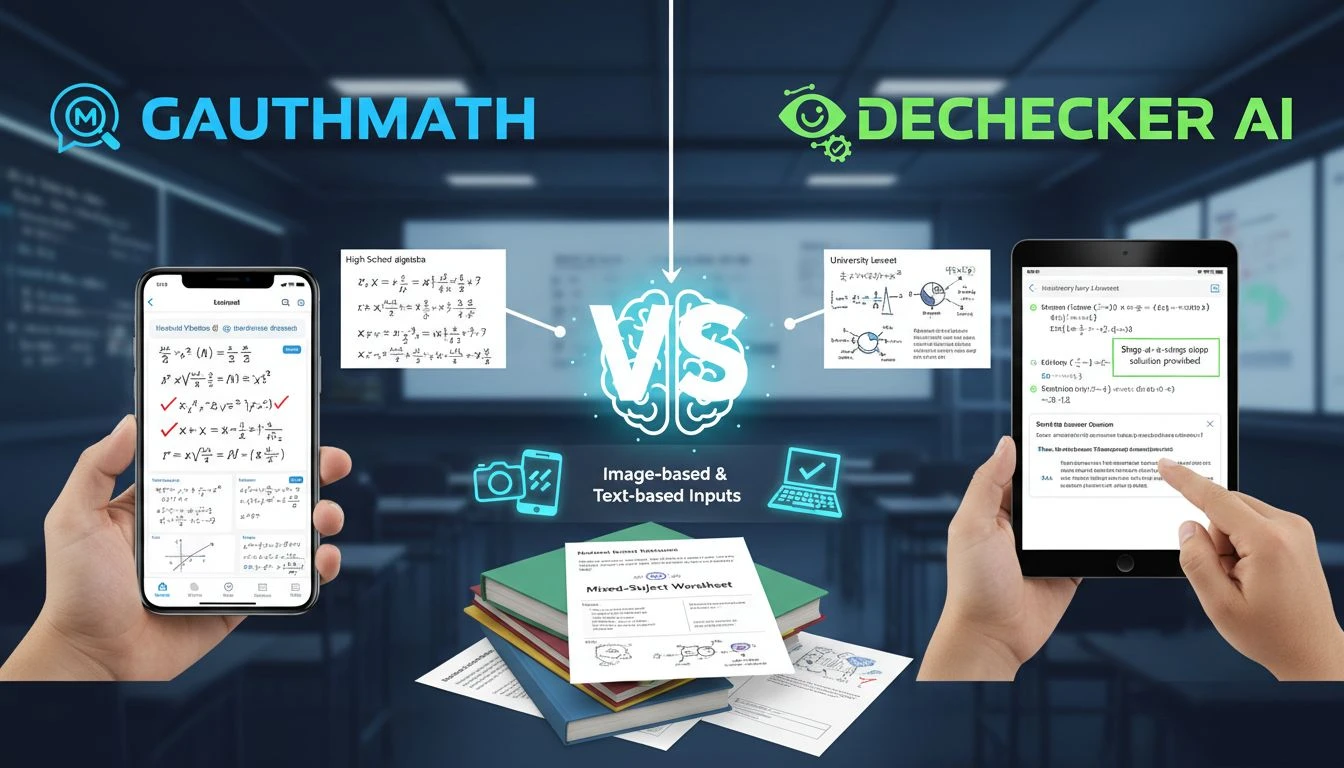
📐 Math Problem Solving Performance
We began with common math tasks such as quadratic equations, word problems, derivatives, and basic geometry proofs.
Gauthmath Results
Gauthmath consistently delivered fast final answers along with short procedural steps. For students who already understand the topic and simply want confirmation, this workflow feels efficient.
However, most explanations remained surface-level. The platform shows what to do but rarely explains why. Key ideas behind formulas or methods are often missing, making it harder for learners to build deeper understanding.
In practice, Gauthmath behaves more like a teaching-oriented AI Math Solver.
Dechecker AI Homework Helper Results
Dechecker takes a noticeably different approach.
For the same math problems, it provided structured step-by-step reasoning, clearer formula breakdowns, and short learning summaries that helped connect procedures to concepts. Students can also switch between quick correction and detailed explanation modes depending on their study goals.
Instead of jumping straight to answers, Dechecker walks learners through the logic — much closer to how a human tutor explains problems. This makes it especially helpful for exam preparation or for students who need conceptual clarity rather than just results.
📚 Multi-Subject Homework Support
Modern assignments rarely stay within a single subject. Students often work on math, physics, chemistry, humanities, and short written responses in one sitting.
This is where the distinction between a math solver and a full AI Homework Helper becomes obvious.
Gauthmath is primarily optimized for mathematics. When testing science theory questions, reading comprehension, or short written tasks, responses became inconsistent or overly brief. The platform simply isn’t built for broad academic coverage.
Dechecker, on the other hand, supports math, science, humanities, and general homework questions within the same interface. It accepts images, PDFs, text input, and mathematical symbols, treating every question as part of a continuous learning flow.
Each response typically includes core explanations, key concept summaries, and related learning suggestions — positioning Dechecker as a true multi-subject AI Homework Helper rather than a single-purpose problem solver.
🖼 Input Formats and User Experience
Usability plays a major role in study efficiency.
Gauthmath Workflow
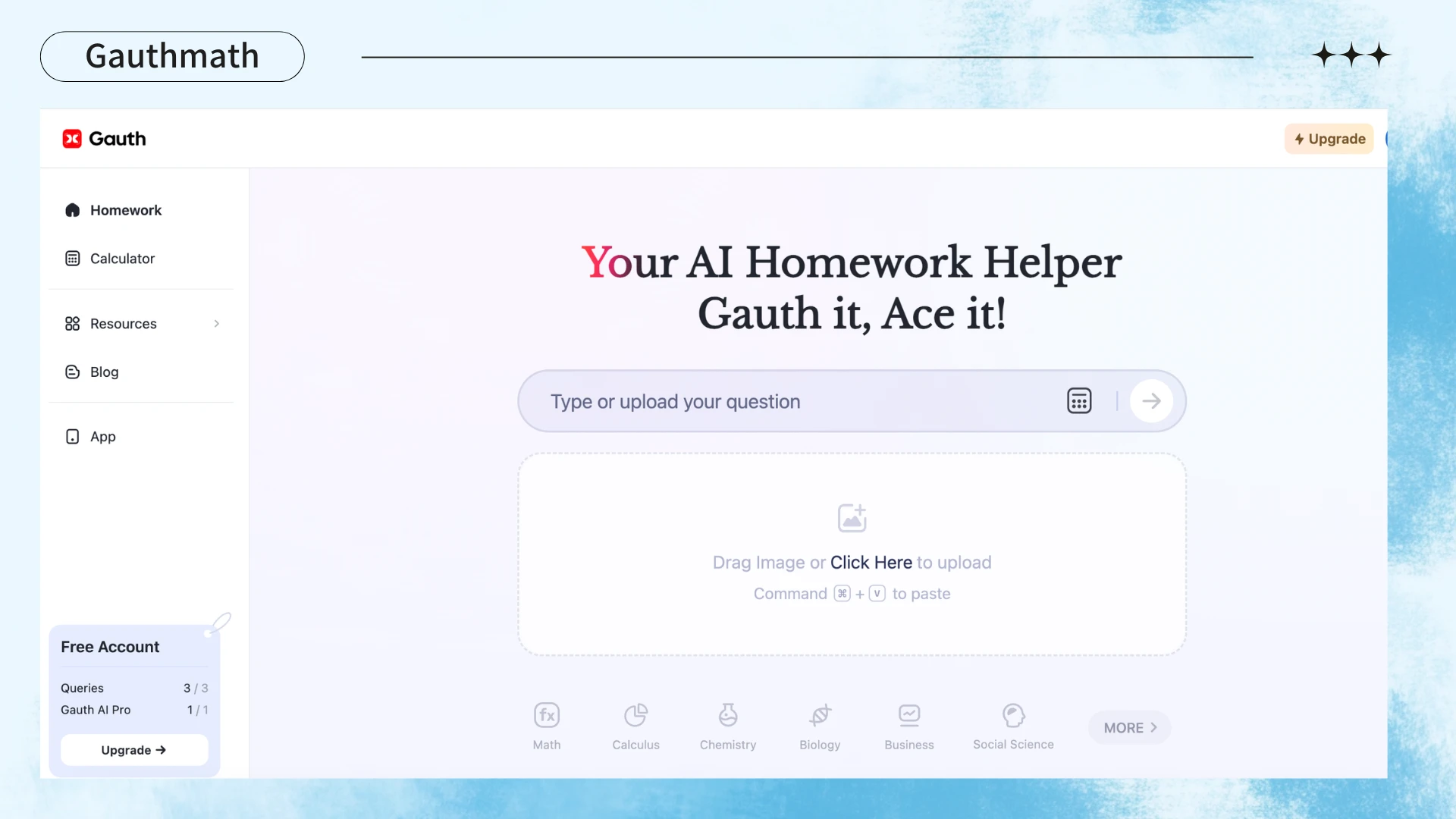
Gauthmath allows image uploads, text input, and calculator access. However, the text input field is hidden in the navigation bar after results load, example questions are absent, and answers appear on separate pages. There is no history tracking, meaning students must manually manage screenshots or browser tabs if they want to revisit previous problems.
Overall, the experience feels fragmented.
Dechecker AI Homework Helper Workflow
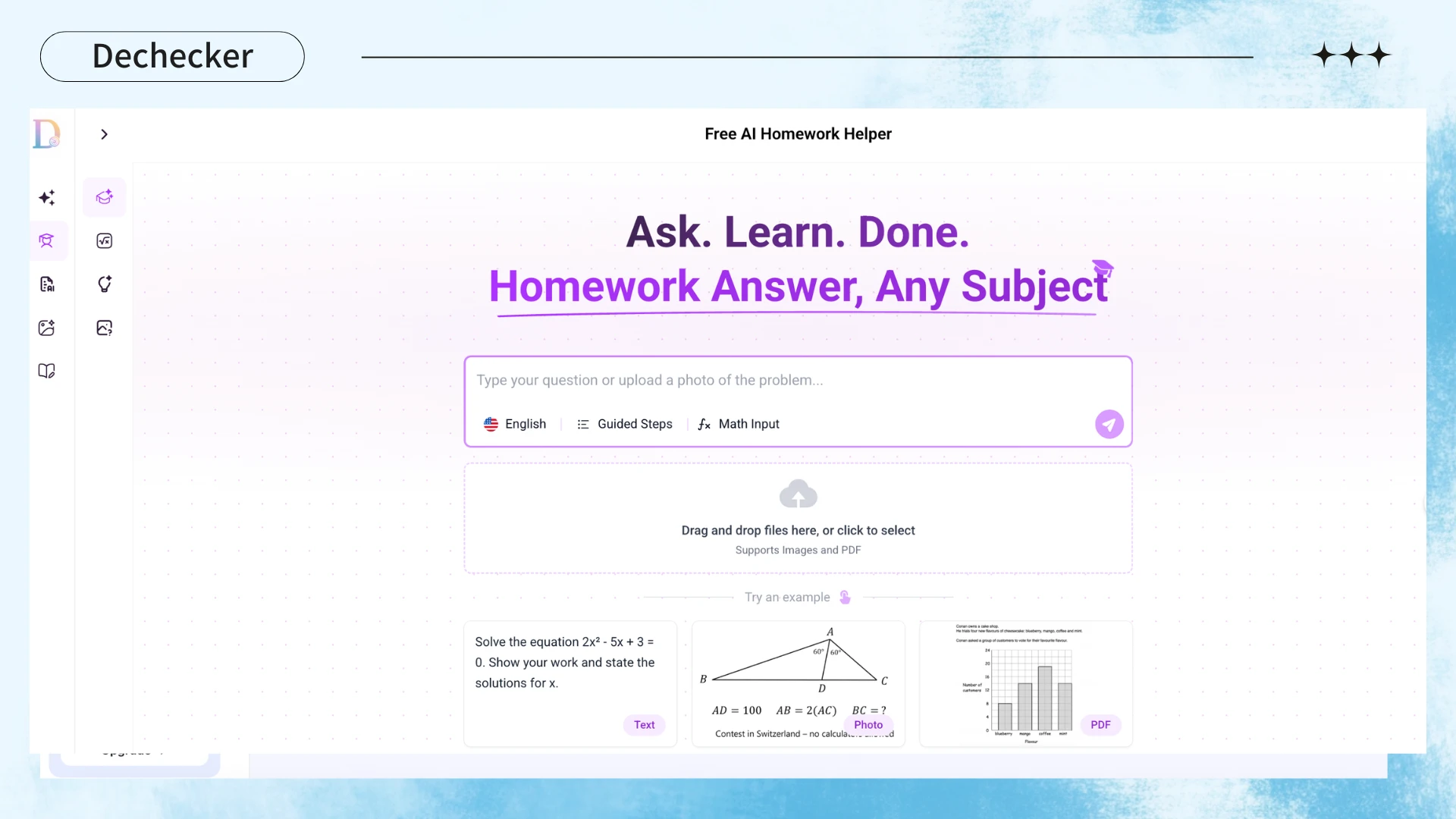
Dechecker offers image uploads with editable OCR, text input, PDF support, and a calculator for mathematical symbols. Sample questions are available for instant trials, and everything remains within one continuous interface.
Additional features such as full history tracking, language selection, and two answer modes help structure longer study sessions. Instead of jumping between pages, students move naturally from one problem to the next, creating a more organized learning experience.
💰 Cost, Limits, and Accessibility
Pricing has a real impact on how students use AI Homework Helper tools.
Gauthmath limits free users to roughly three questions per day with simplified explanations. After that, learners are prompted to upgrade, and many advanced features remain locked behind paid plans.
Dechecker AI Homework Helper is completely free. There are no daily limits, no restricted explanation modes, and no subject-based constraints. Students can upload multiple assignments, revisit history, switch learning modes, and explore summaries without worrying about quotas.
This changes behavior in a meaningful way: instead of rationing questions, learners are free to experiment, practice, and review as much as they need.
🔄 Daily Study Flow Comparison
Let’s look at how students actually interact with each AI Homework Helper during a typical homework session.
With Gauthmath, the process usually follows a simple loop: take a photo, upload the problem, receive an answer, copy the result, and repeat until the daily limit is reached. Each question feels isolated, with little continuity between sessions.
Dechecker supports a more connected study flow. Students upload or type homework, receive structured explanations, review learning summaries, try follow-up problems, revisit previous questions through history, and switch between quick or detailed modes when needed. Instead of one-off answers, the experience feels closer to guided learning.
At this point, the practical differences between the two tools become clear. To make those differences easier to compare at a glance, here’s a side-by-side feature overview.
📊 AI Homework Helper Feature Comparison
| Feature | Gauthmath (Free) | Gauthmath (Pro) | Dechecker AI Homework Helper |
|---|---|---|---|
| Math Problem Solving | ✔️ | ✔️ | ✔️ |
| Multi-Subject Support | ✔️ | ✔️ | ✔️ |
| Image Upload | ✔️ | ✔️ | ✔️ |
| PDF Upload | ❌ | ❌ | ✔️ |
| Text Input | ✔️ | ✔️ | ✔️ |
| Editable Image OCR | ❌ | ❌ | ✔️ |
| Step-by-Step Explanations | Limited | ✔️ | ✔️ |
| Learning Summaries | ❌ | ❌ | ✔️ |
| History Tracking | ❌ | ❌ | ✔️ |
| Daily Usage Limits | ✔️ | ❌ | ❌ |
| Example Questions | ❌ | ❌ | ✔️ |
| Pricing | Free (Very Limited) | Paid | Free |
Rather than focusing on a single strength, this comparison highlights a broader difference in design philosophy.
Gauthmath centers on fast math answers. Dechecker is built as a full AI Homework Helper — supporting multiple subjects, continuous learning, and unlimited practice without paywalls.
🎯 Choosing the Right AI Homework Helper Based on Learning Needs
Different students prioritize different outcomes.
For quick math snapshots, Gauthmath works well. It’s fast and straightforward.
For multi-subject homework involving math, science, reading, and written responses, Dechecker clearly provides broader support.
For learners focused on deep understanding through step-by-step reasoning and concept summaries, Dechecker offers a richer experience.
And for long-term study — including exam preparation or weekly assignment management — features like unlimited usage, history tracking, and flexible explanation modes make Dechecker a stronger AI Homework Helper.

🧭 Final Verdict: Which AI Homework Helper Is Right for You?
Gauthmath does one thing well: it solves math problems quickly.
But today’s students need more than answers. They need explanations, flexibility, and tools that support multiple subjects while encouraging real understanding.
That’s where Dechecker stands apart.
As a modern AI Homework Helper, Dechecker offers multi-format input, multi-subject coverage, quick or detailed answer modes, learning summaries, editable image parsing, full history tracking, and completely free access. It doesn’t just help students finish homework — it helps them learn from it.
Whether you’re building foundations in middle school, handling complex university assignments, or exploring new topics as a self-learner, choosing the right AI Homework Helper can reshape how you study. Among current options, Dechecker delivers one of the most balanced and learner-focused experiences available today.