
With the rapid adoption of AI-generated content, choosing the right AI detector is more important than ever. Copyleaks and Dechecker are two of the most widely used tools, but their approaches differ significantly.
Quick summary:
The ideal choice depends on your use case: academic verification, professional content creation, or hybrid content management.
| Feature | Dechecker | Copyleaks |
|---|---|---|
| Accuracy (Pure AI text) | ~96% detection rate | ~98% detection rate |
| Accuracy (Human text) | ~92% correct classification | ~85–90% (higher false positives) |
| Mixed Content | Strong performance (~90%) | Moderate (~80–85%) |
| Ease of Use | Very simple | Moderate complexity |
| Extra Features | Rewrite, downloadable reports, sharing | API, plagiarism detection |
| Speed | Fast | Moderate |
| Best Use Case | Academic institutions, SEO professionals | Academic institutions, enterprises |
Key Insights:
Dechecker is designed not only to detect AI-generated text but also to improve, report, and share content. Key functionalities include:
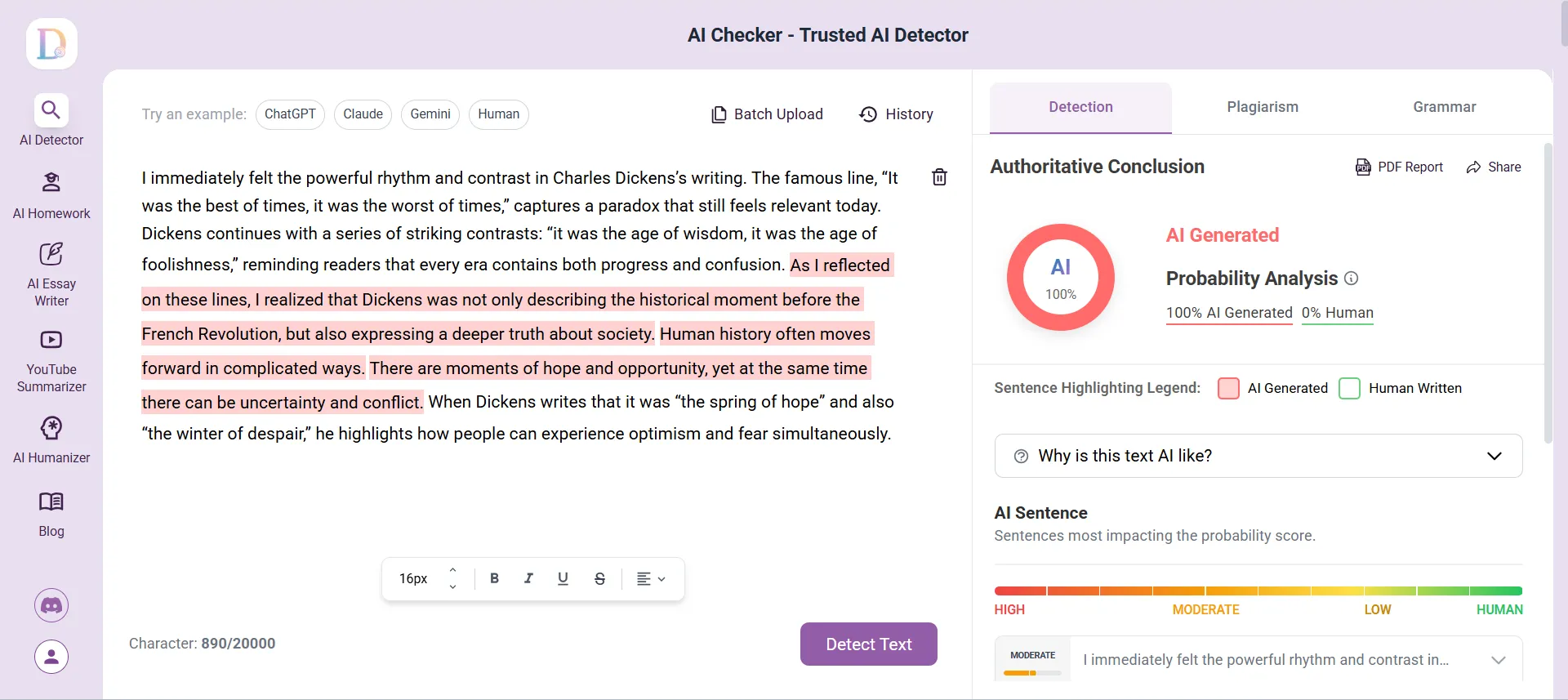
Example Scenario: A freelance writer uses Dechecker AI detector to analyze a GPT-5 draft, identify AI-generated segments, refine them with the AI Humanizer, and provide a downloadable report to a client. This workflow reduces errors and maintains quality.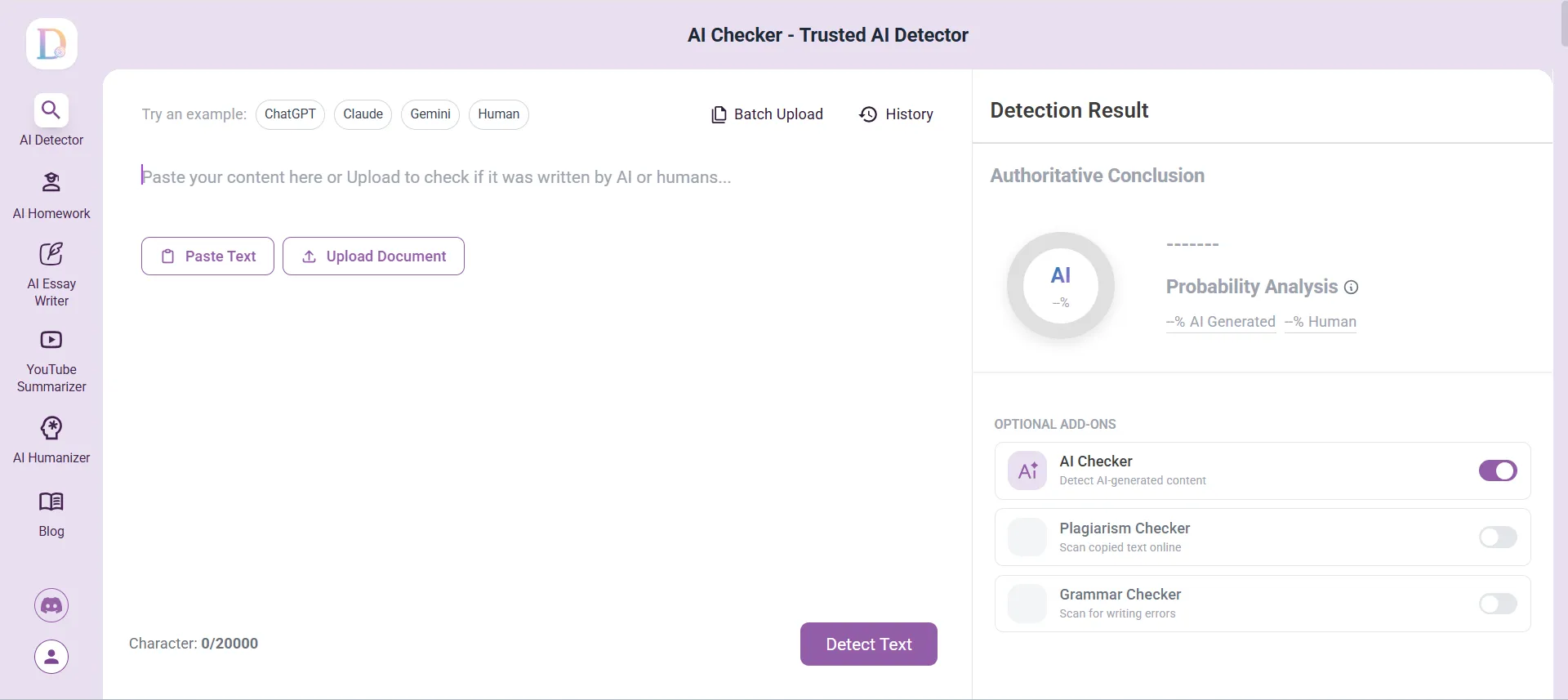
Dechecker employs advanced NLP algorithms to identify AI-generated patterns:
By combining these metrics, Dechecker evaluates each text segment and assigns confidence scores, allowing nuanced analysis rather than a binary classification.
Dechecker’s biggest advantage lies in how well it adapts to real-world content workflows, rather than just theoretical detection accuracy.
Unlike most AI detectors that restrict usage behind paywalls or credits, Dechecker is fully free with unlimited access.
This creates a huge advantage:
Why it matters:
In real usage, detection is rarely a one-time action. Writers often need 3–5 rounds of refinement, which becomes costly with paid tools—but effortless with Dechecker.
Modern content is rarely 100% AI-generated. Most users:
Dechecker is specifically designed for this reality.
Instead of labeling everything as AI, it:
Impact:
You get precision instead of overgeneralization, which dramatically improves usability.
Most AI detectors stop at telling you “this is AI-generated.”
Dechecker goes further:
This turns it from a passive tool → active assistant.
Why this is important:
Detection alone doesn’t solve the problem.
Dechecker actually helps you fix and improve content immediately.
False positives are one of the biggest issues in AI detector today.
Dechecker is tuned to:
Practical benefit:
Instead of using multiple tools, Dechecker AI detector combines:
Result:
A smoother, faster workflow with fewer context switches.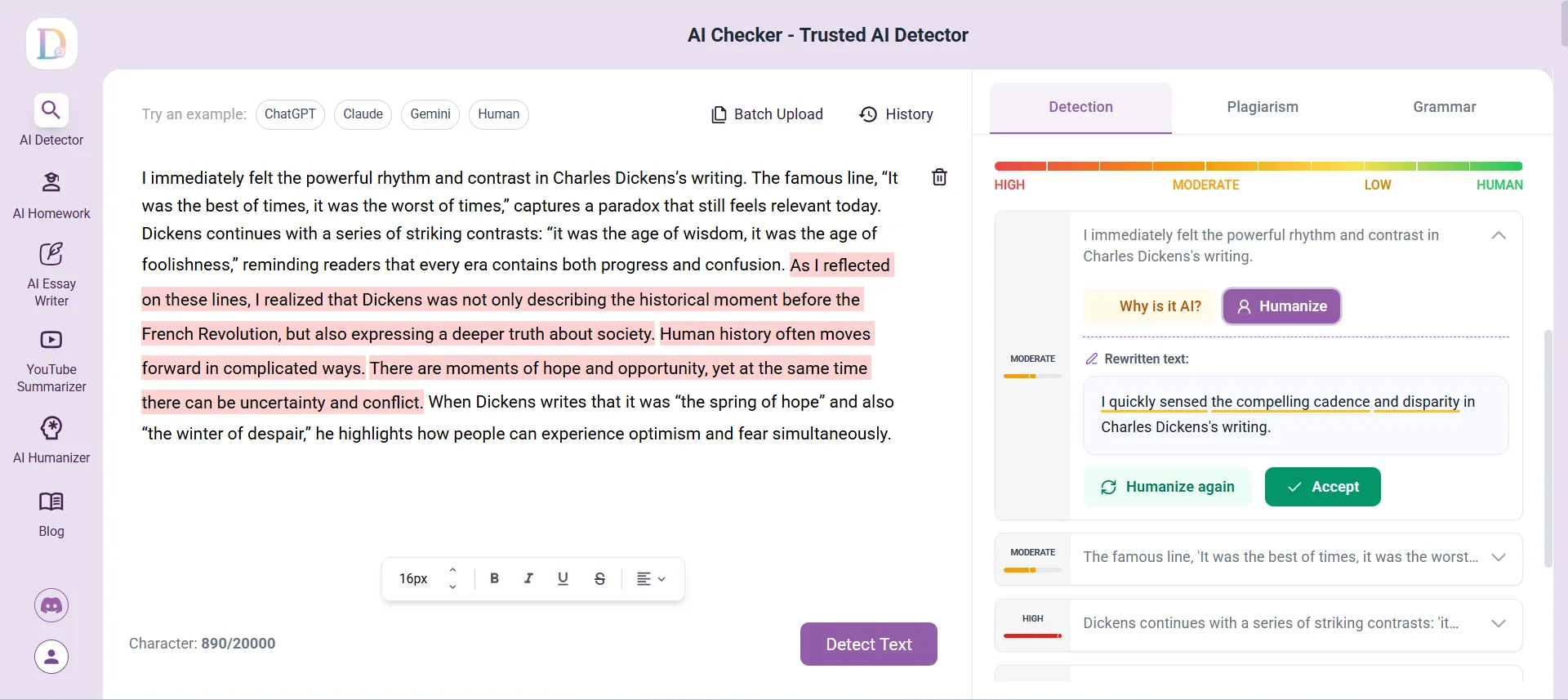
Dechecker AI detector shines in scenarios where content quality, efficiency, and usability matter more than strict enforcement.
For SEO writers and bloggers, speed and scalability are critical.
Typical workflow:
Why Dechecker works well:
Freelancers often face trust issues when using AI detector tools.
With Dechecker, they can:
Real benefit:
Students increasingly use AI for drafting—but need to avoid detection risks.
Dechecker helps by:
Outcome:
Editors can use Dechecker as a quality control layer.
It helps:

For teams producing large volumes of content:
Dechecker’s free and unlimited model makes it scalable without cost concerns.
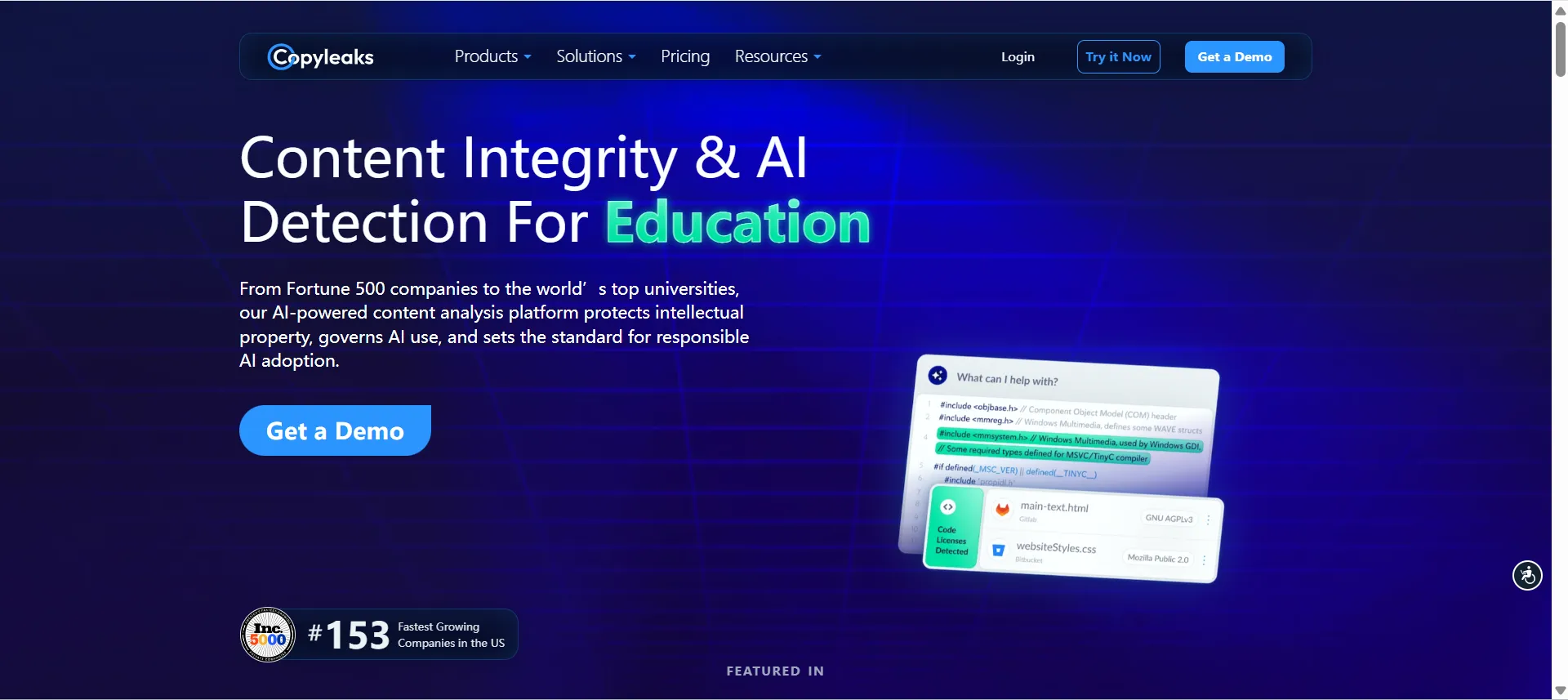
Copyleaks is a well-established AI detector platform popular in academia and enterprise. It offers:
Example Scenario: A university professor scans 500 essays, using Copyleaks to ensure that AI influence is detected across multiple languages, providing confidence in grading integrity.
Copyleaks uses proprietary AI models trained on diverse datasets:
This makes Copyleaks reliable for formal documents but may misclassify edited or hybrid content.
Copyleaks is designed for environments where accuracy must be strict, defensible, and scalable.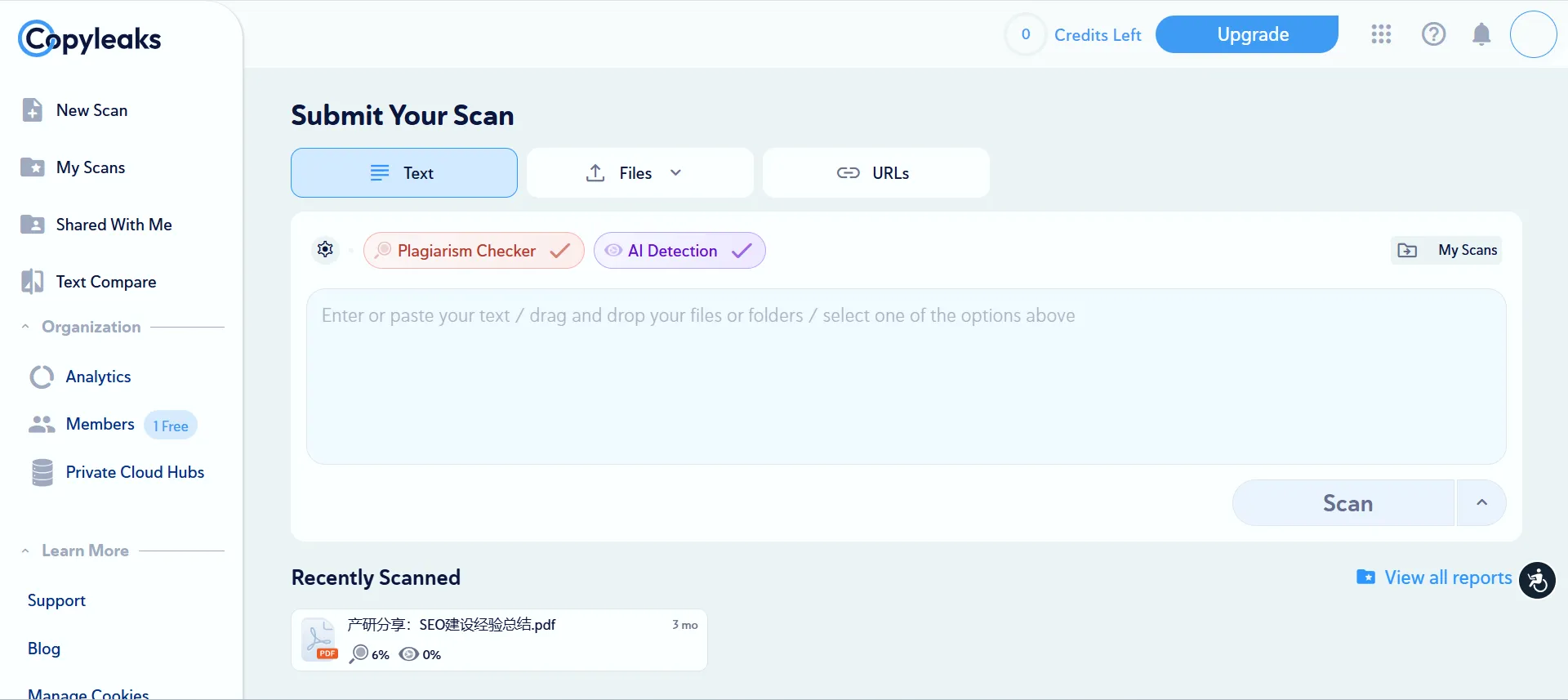
Copyleaks is extremely good at identifying:
What this means:
It catches content that other tools might miss.
Trade-off:
Higher sensitivity can lead to more false positives.
Copyleaks is built for institutional trust.
It is widely used in:
Why this matters:
Decisions made using Copyleaks results can be defended and standardized.
Unlike many AI detector, Copyleaks supports:
Use case:
Global institutions or multilingual teams can apply consistent detection standards.
Copyleaks offers:
Impact:
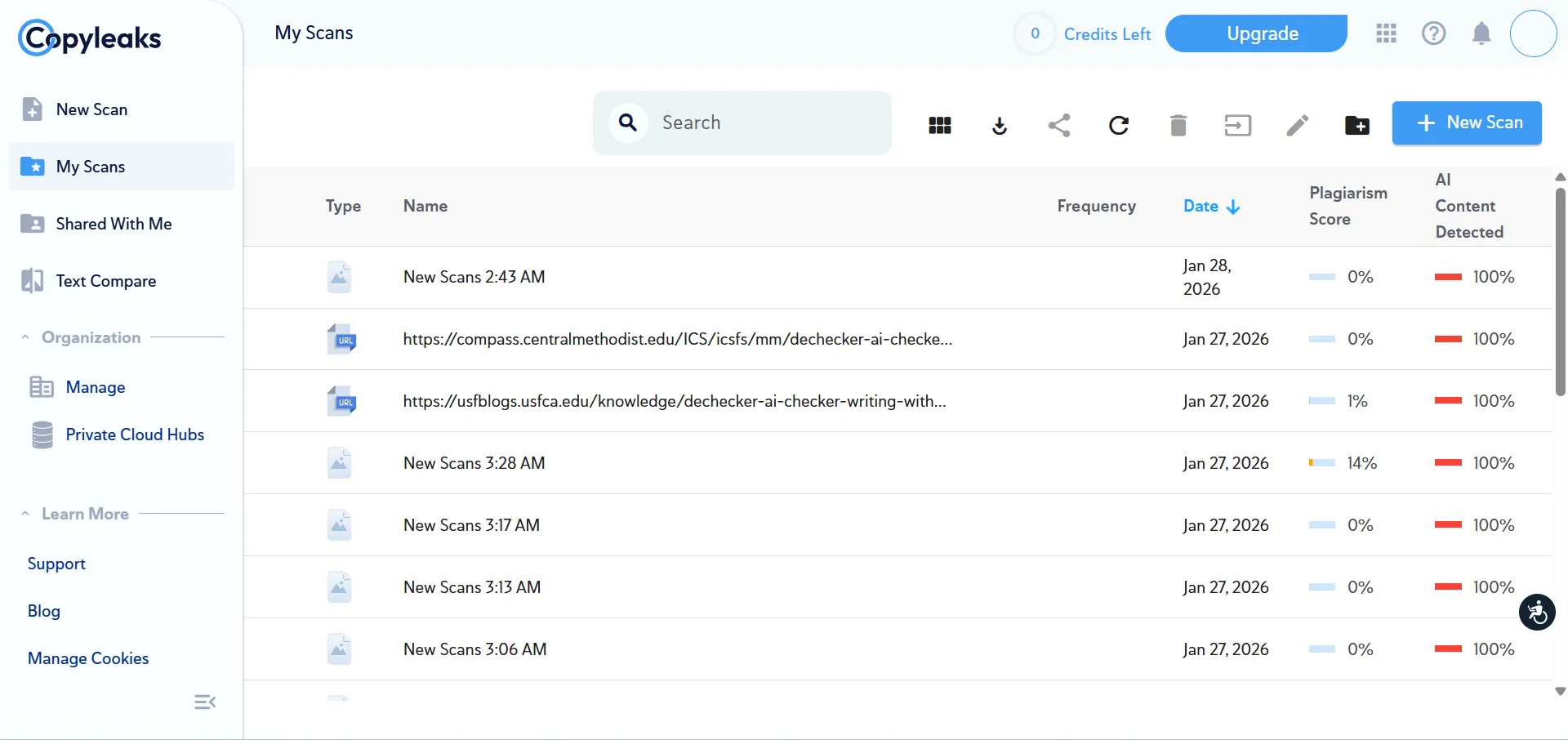
Copyleaks goes beyond AI detector by also offering:
Advantage:
A more complete academic integrity solution.
Copyleaks performs best in high-stakes, rule-driven environments.
Universities use Copyleaks AI detector to:
Why it works:
Teachers benefit from:
Example:
A teacher reviewing 100 essays can quickly flag suspicious submissions.
Companies use Copyleaks to:
Publishers need to maintain:
Copyleaks helps ensure:
For enterprises handling thousands of documents:
make Copyleaks a strong choice.
Both tools were evaluated on three content types:
Sample size: 500 documents per category, with cross-validation for reliability.
| Content Type | Dechecker Accuracy | Copyleaks Accuracy |
|---|---|---|
| Pure AI (GPT-5) | 96% | 98% |
| Human-written | 92% | 88% |
| Hybrid (edited AI) | 90% | 82% |
Insights:
Case Study 1: Blog Article (~1,500 words, AI draft + 30% human edits)
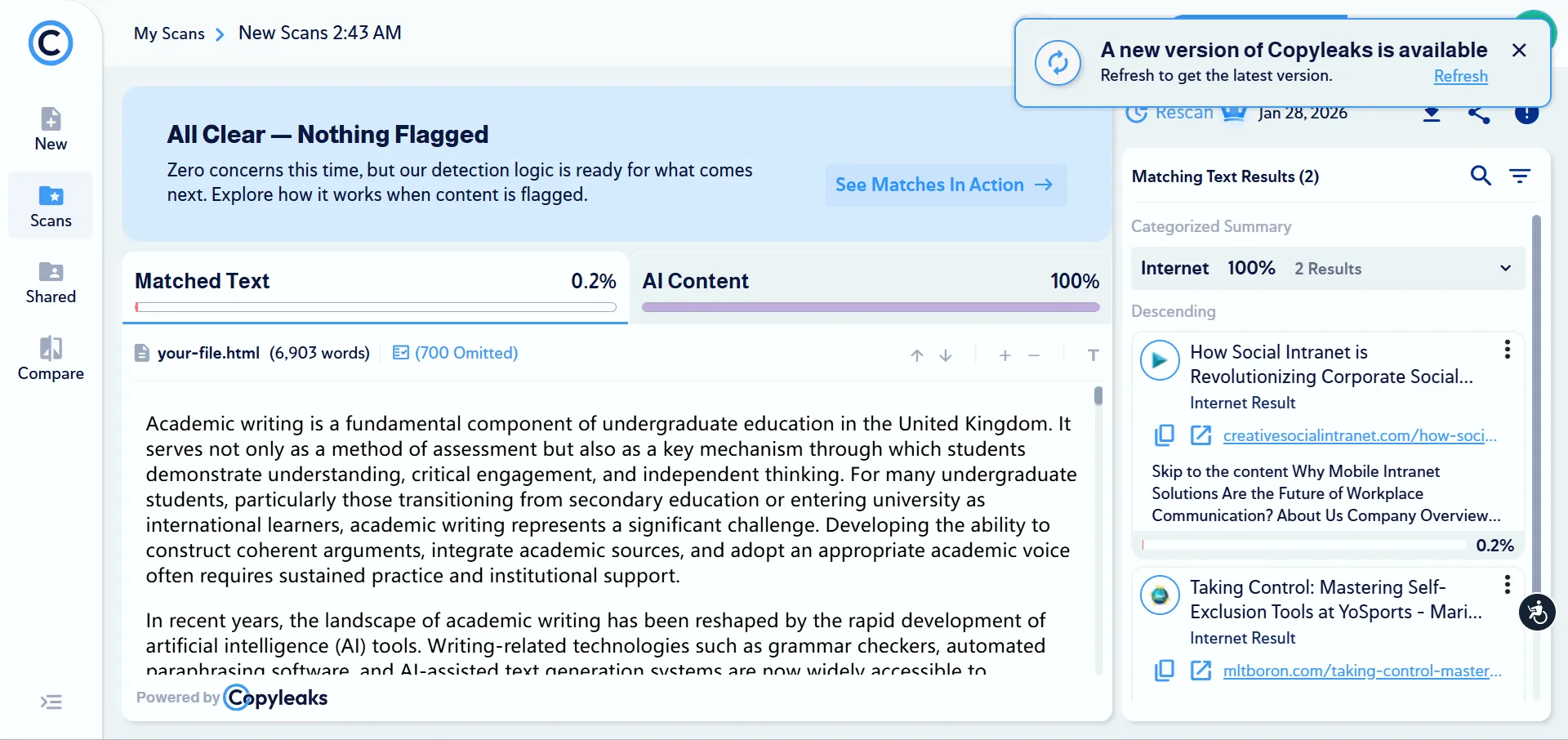
Case Study 2: Academic Essay (AI draft lightly edited)
Conclusion: Dechecker provides actionable insights while minimizing false positives.
Dechecker is fully free, with no limits on usage. Features include:
This makes it ideal for freelancers, students, and content creators, providing maximum value without cost.
Copyleaks uses subscription or credit-based pricing, suited for:
While powerful, the pricing may not justify casual or low-volume use.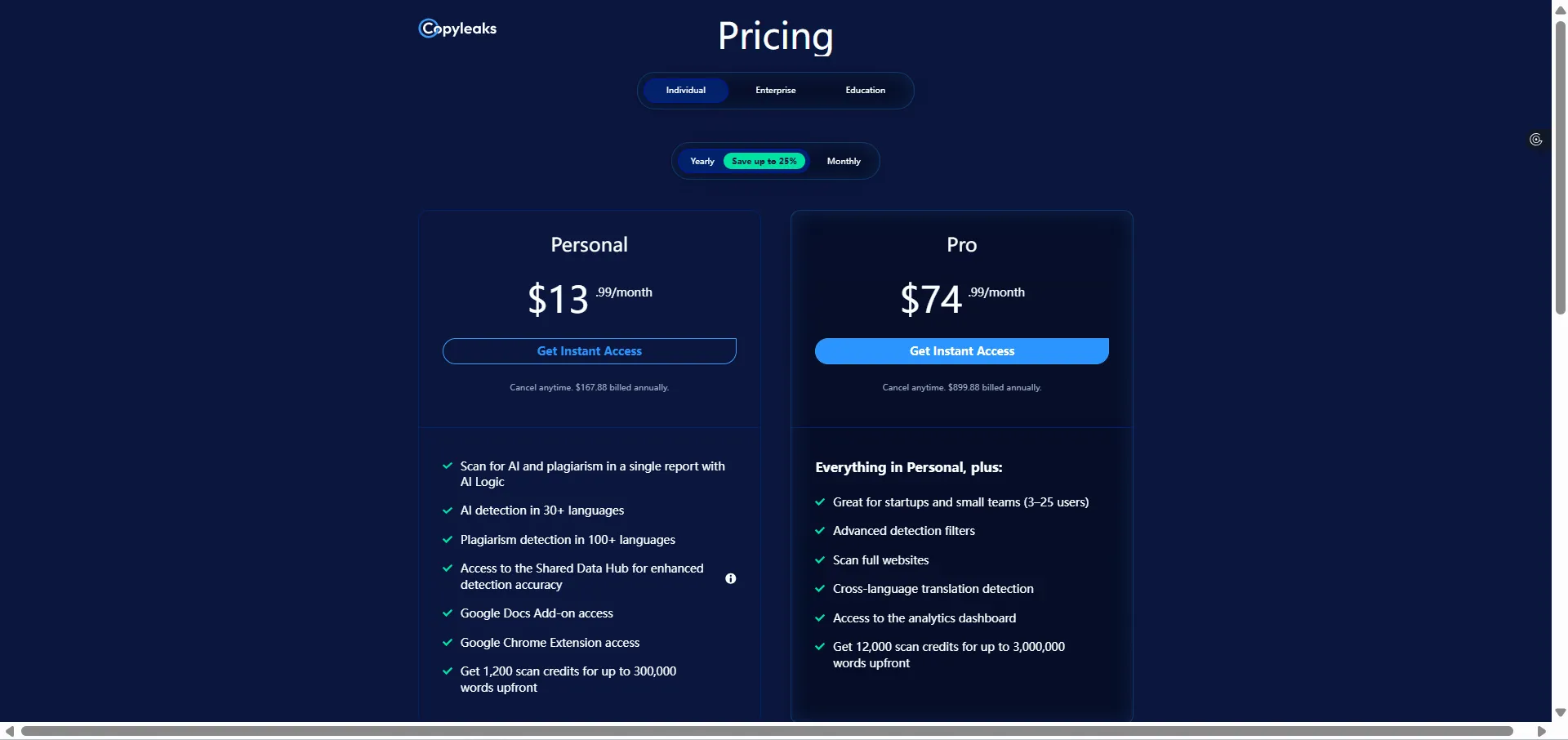
Choosing the right AI detector depends heavily on your use case, content type, and workflow. Both Copyleaks and Dechecker are powerful, but their strengths lie in different areas.
Dechecker is ideal for users who deal with hybrid content—text that is part AI-generated, part human-edited. Its segment-level detection highlights AI-generated sections, while the AI Humanizer allows you to rewrite problematic parts, making your content more natural and human-like.
Example Scenario 1:
A freelance writer drafts a 2,000-word article using GPT-5, edits it for style and readability, and then uses Dechecker to detect remaining AI-generated phrases. Dechecker not only flags the AI content but also suggests rewrites and allows the writer to export a detailed report for a client, streamlining the review process.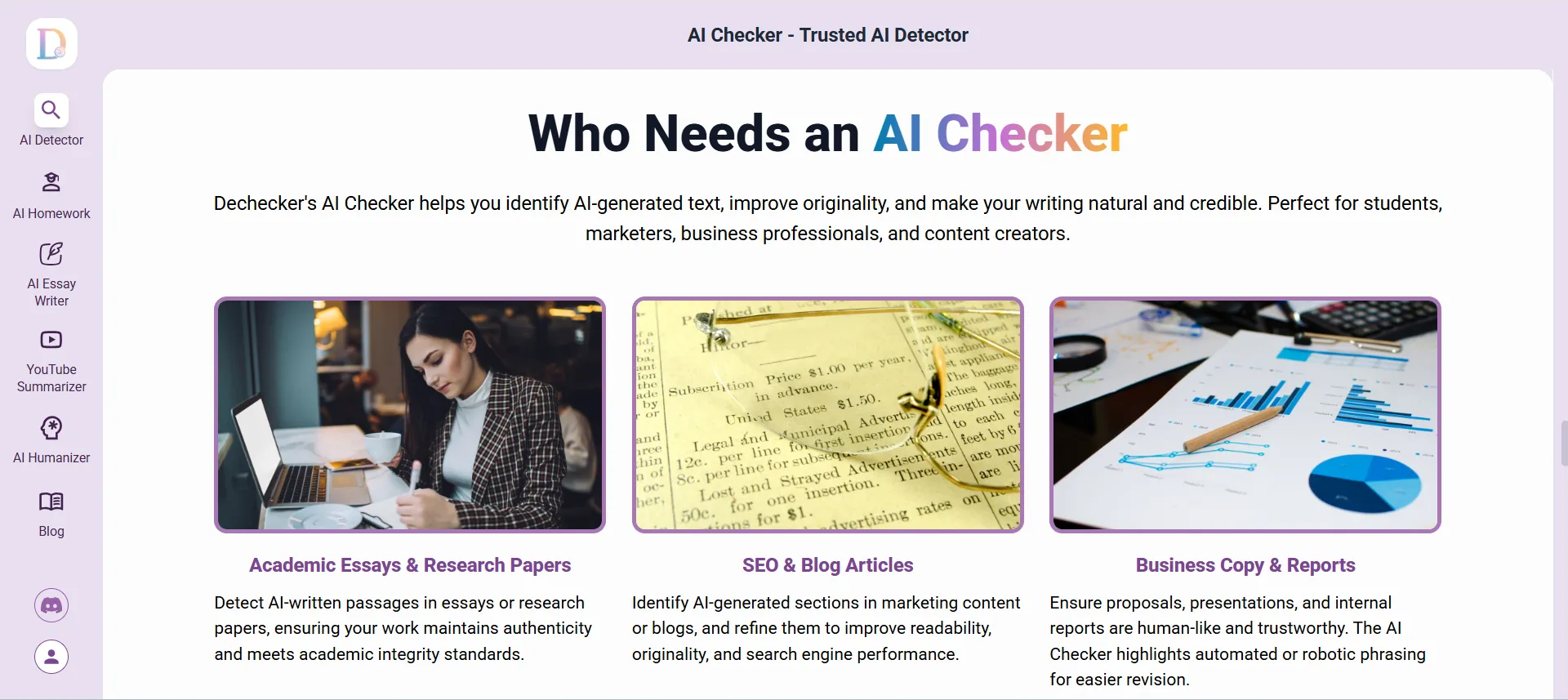
Example Scenario 2:
An SEO professional manages multiple blog posts daily. Using Dechecker, they can quickly check drafts, adjust AI-generated sections, and ensure that all content meets originality and quality standards. This workflow saves hours of manual editing and reduces the risk of duplicate or formulaic AI phrases slipping into published content.
Key Advantages of Choosing Dechecker:
Copyleaks is better suited for academic, institutional, or enterprise environments where strict detection and compliance are critical. Its detection algorithms are fine-tuned to flag even lightly edited AI-generated content, which is why many universities and companies rely on it for integrity checks.
Example Scenario 1:
A university professor grading hundreds of student essays uses Copyleaks to ensure no AI-generated content is undetected. Copyleaks flags essays that contain AI-style patterns, even if the student has edited portions.
Example Scenario 2:
A corporate content compliance team monitors internal reports and marketing content for AI influence. Copyleaks’ batch scanning and API integrations allow them to automatically process thousands of documents efficiently.
Key Advantages of Choosing Copyleaks:
Practical Rule:
Tip: If your workflow involves both casual and formal content, you might even use both: Dechecker for editing and refinement, and Copyleaks for compliance checks before final submission.
Selecting an AI detector isn’t just about accuracy percentages—it’s about workflow integration, practical usability, and cost-effectiveness. Both Dechecker and Copyleaks have clear advantages, depending on your needs.
Dechecker shines in real-world scenarios where content is rarely fully AI-generated. Its combination of detection, rewriting, and report generation makes it highly practical for content creators, bloggers, and students. The fact that it is completely free gives it a significant edge over paid competitors, especially for small teams and individual users.
Copyleaks, on the other hand, excels in high-stakes environments where every AI-generated segment must be detected with high confidence. Its robust enterprise features, API integrations, and multi-language support make it a strong choice for universities, large organizations, and compliance-focused workflows.
Key Takeaways:
Ultimately, the best AI detector is the one that fits your workflow: balancing detection needs, usability, and budget considerations.
Answer: Dechecker is ideal because it highlights AI-generated sections while providing rewriting suggestions. Copyleaks may label hybrid content entirely as AI-generated, which can lead to false positives and unnecessary corrections.
Answer: No. Short text, heavily edited AI drafts, or creative human rephrasing can evade detection. Dechecker’s segment-level approach helps identify patterns without over-penalizing content, whereas Copyleaks prioritizes stricter classification.
Answer: Extremely critical. False positives can lead to misunderstandings, lost client trust, or academic penalties. Dechecker minimizes false positives while maintaining high detection accuracy, making it safer for professional and educational contexts.
Answer: Copyleaks has robust multi-language support, ideal for universities or global enterprises. Dechecker primarily supports English but is expanding capabilities to other languages, still focusing on high detection accuracy for English content.
Answer:
Answer: Dechecker is fully free and feature-rich, offering detection, rewriting, and reporting without payment. Copyleaks is paid and better suited for institutions or enterprises with high-volume needs.
Answer: Yes. Dechecker is completely free with unlimited usage for students, freelancers, bloggers, or small teams. There’s no hidden subscription or paywall, making it accessible to all users.
Answer: Absolutely. Many users benefit from using Dechecker for content creation, refinement, and client deliverables, then using Copyleaks for final academic or enterprise compliance checks. This hybrid workflow leverages the strengths of both tools.