
Homework has always been a quiet pressure in learning. It waits on desks, screens, and notebooks, asking for time, focus, and patience. Some questions look short but hide layers of logic. Others bring long formulas, dense reading, or unclear instructions. Many students pause not because they refuse to work, but because they hesitate. They wonder where to start, whether their thinking is correct, or how much time they should spend before asking for help—questions that sit at the center of how to study effectively.
In recent years, study habits have changed. Search engines replaced libraries for quick answers. Video lessons replaced parts of classroom review. Now, a new kind of learning tool is stepping into daily study routines: the AI Homework Helper.

An AI tool does not replace effort. It reshapes how effort is spent. Instead of guessing the first step or repeating the same mistake, learners focus on understanding the logic behind a question, seeing how a solution unfolds, and testing their thinking through interaction—practical habits that sit at the core of how to study effectively. This guide looks at how these tools support real homework and study tasks, where they fit into everyday learning, and how people use them to move forward instead of staying stuck.
Before talking about tools, it helps to look at behavior. Many learners know the feeling of staring at a question while time passes. The mind jumps between options: skip it, search for the answer, or give up for now. This hesitation is not laziness. It is judgment. The brain weighs effort against reward.
Homework becomes difficult when:
Traditional help often arrives too late. A teacher explains the solution the next day. A parent remembers a different method from years ago. Online answers show results but skip reasoning. The learner sees what happened, but not why.
This is where AI-based study support changes the rhythm of studying. It meets learners at the moment of confusion, not after it.

An AI Homework Helper refers to a category of AI-based study tools designed to support homework and learning through step-by-step guidance, explanations, and interactive feedback. Unlike simple answer generators, it places more weight on the thinking process—an approach closely tied to how to study effectively over time.
Instead of only producing results, it works through the input itself. Learners can type in questions, upload images of handwritten problems, or share PDFs. The system then breaks the problem down into logical steps, allowing users to pause, ask follow-up questions, request alternative methods, or slow the explanation when something does not click.
The difference is not technical. It is intentional. Traditional solutions aim to finish the task. An AI Homework Helper is built to support understanding, especially when learners are unsure which step comes next.
It is easy to mistake AI tools for shortcuts. That assumption misses what makes this type of helper useful. A well-designed AI Homework Helper does not rush to the end. It lingers at the points where people usually hesitate. It explains why one step matters before moving forward.
Instead of replacing thinking, it reinforces it—helping learners practice better judgment, not just faster completion.

Learning no longer happens in a single place. Students move between classrooms, online platforms, group chats, and personal study time. Homework sits in the middle of this flow.
An AI Helper fits into this environment because it adapts. It responds when learners need clarification, not when a scheduled session allows it. This flexibility matters more than speed.
Recent education research shows that immediate feedback improves retention, especially in problem-solving subjects like math, physics, and chemistry. Delayed correction allows incorrect reasoning to settle. An AI Homework Helper reduces that delay.
Homework rarely arrives in clean text form. It appears as:
Modern AI-based homework support accepts these formats. Instead of rewriting questions, users upload them directly. This lowers resistance and keeps focus on learning.
Confidence grows through clarity. When learners see each step explained, they begin to trust their own reasoning—an essential part of studying effectively. This kind of support breaks complex problems into manageable parts, making logic visible.
This matters especially in math and science, where one small mistake can derail the entire solution.
Homework does not belong to one subject or one language. An effective AI Homework Helper supports:
This flexibility allows users to switch contexts without switching tools.
Human hesitation often comes from fear of asking “simple” questions. This kind of learning support removes that social pressure. Learners can ask the same question again, request a slower explanation, or explore another method without feeling judged.
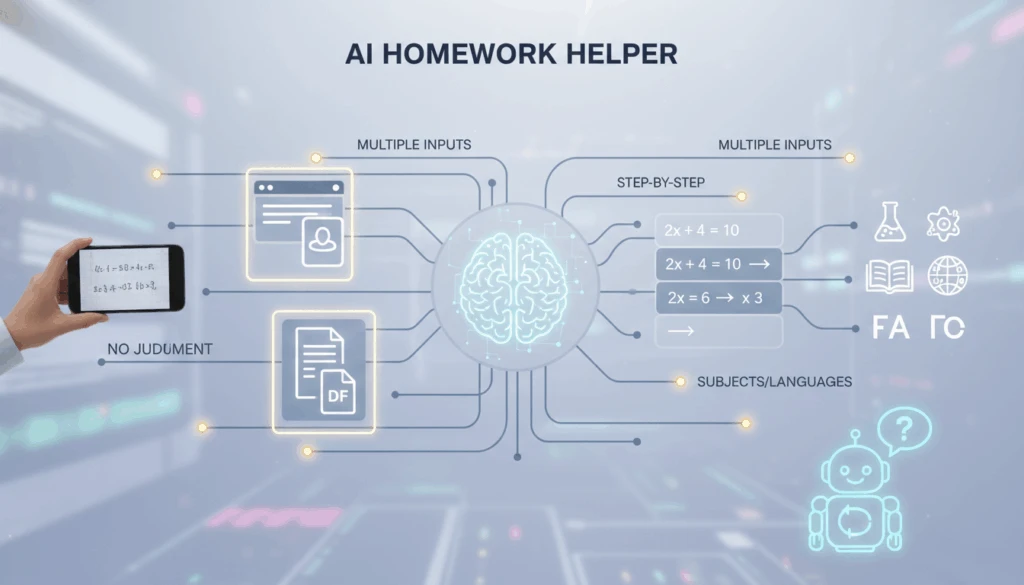
Students often use this kind of support to:
Instead of copying answers, they test their reasoning against clear explanations—an important part of learning how to study effectively.
Parents often want to help but face gaps in subject knowledge or time. In those moments, a shared explanation matters more than speed. Clear, step-by-step guidance gives parents and children something to look at together, reducing frustration on both sides.ation on both sides.
Teachers often treat AI tools as reference points rather than answers. Seeing alternative solution paths or examples can spark ideas for lesson planning or classroom discussion, especially when students approach the same problem in different ways.
Adults studying for certifications or skill upgrades often feel pressure to relearn fundamentals quickly. It allows them to revisit basics without embarrassment, moving at their own pace.

The shift in how people study is not cosmetic. It is structural.
What changes is not only the presence of new tools, but the way learners interact with problems. Instead of moving quickly from question to answer, study sessions increasingly revolve around understanding why a method works, where mistakes appear, and how different approaches connect.
This shift turns homework from a task to complete into a process to navigate. Attention moves away from final results and toward reasoning, reflection, and adjustment—habits that define more effective study over time.
This change is easiest to see in how solutions themselves are presented.
Traditional approaches tend to emphasize output. Results appear quickly, often without context. Interaction is limited, and reasoning is compressed or skipped. They deliver results quickly, often without context. Interaction is limited, and reasoning is compressed or skipped.
A more learning-centered approach shifts attention to process. Problems are broken into steps, methods are explained as they appear, and learners can pause to question or rethink at any point. One approach finishes tasks. The other strengthens thinking.
Efficiency does not mean moving faster. It means avoiding repeated dead ends. With guided feedback, learners can spot where reasoning drifts off course and correct it early.
Time is saved not by skipping effort, but by reducing unnecessary repetition. Study sessions feel smoother and more controlled.
Homework rarely stays inside one subject. Writing assignments depend on structure. Science problems lean on math. Modern learning tools handle these overlaps naturally.
Learners refine arguments, test assumptions, and explore cause-and-effect relationships in context. This mirrors how knowledge connects outside the classroom.
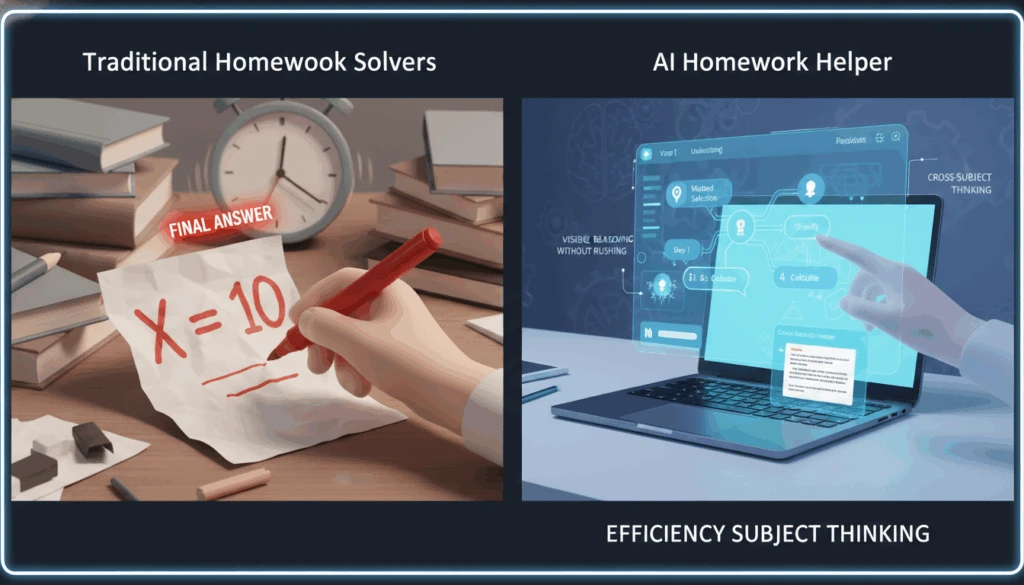
Using an AI Homework Helper well is not about clicking a button and waiting for an answer. It is about how you interact with the tool at each step. The same question can lead to very different learning outcomes depending on how it is entered, reviewed, and applied.
Below is a practical way to study with the AI Homework Helper that mirrors how real learners actually use it during homework and revision.
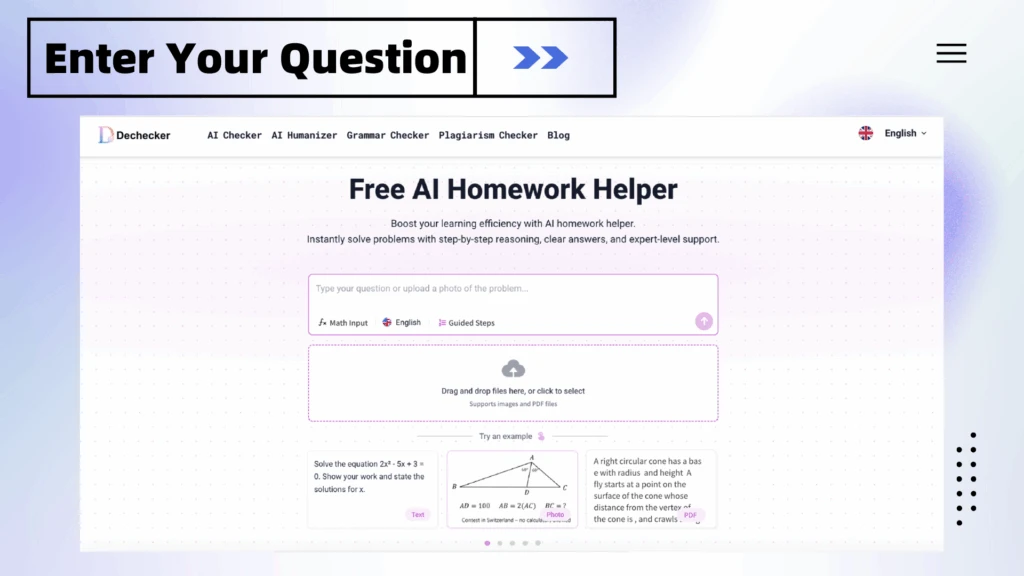
Start by entering the homework question in the format that feels most natural. You can type the problem directly, upload an image of handwritten work, submit a PDF worksheet, or use a math keyboard for formulas and symbols.
Before submitting, take a moment to check one thing:
Is the full question visible, including conditions, diagrams, and units?
Small missing details often cause confusion later. A clear input helps the homework solver focus on the correct subject, method, and level of difficulty. Many tools also allow you to choose an output language and explanation style. Selecting these early shapes how the solution will be presented.
If you are unsure how to phrase the question, using a sample example can help you understand what a well-structured input looks like.
After submitting the question, generate the solution. At this stage, the AI Homework Helper analyzes the problem using subject-specific logic, verified methods, and structured reasoning.
Do not rush past this moment. Notice how the tool frames the problem:
These choices mirror how experienced learners think. Watching this process helps train your own problem-solving habits.

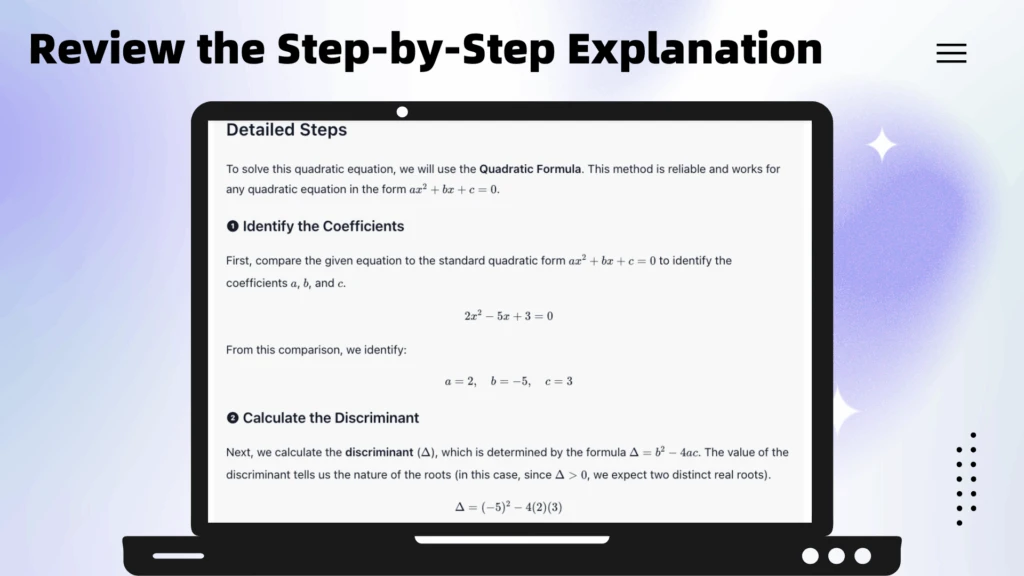
Read the full explanation from start to finish, even if you think you already know the answer. Each step usually builds on the previous one, and skipping ahead can hide small but important assumptions.
A strong AI Homework Helper explains:
If a step feels too fast or unclear, pause. This is where many learners usually move on without fully understanding. Instead, ask a follow-up question or explore another explanation. Being able to revisit a single step without starting over is what makes this kind of support especially effective.
Once the solution is complete, focus on the method summary. This is where learning happens. Ask yourself:
Many learners make the mistake of copying results and moving on. A better approach is to treat the explanation as a short lesson. The AI Homework Helper gives structure, but the learner decides whether to absorb it.

The final step is action. Try solving a similar problem without assistance. If you make a mistake, compare it with the earlier explanation and adjust your thinking.
You can also:
Learning becomes durable when ideas are reused. An AI Homework Helper supports this cycle by staying available as you experiment, revise, and improve.
Used this way, an AI Homework Helper becomes more than a homework solver. It becomes a study partner that adapts to your pace, responds to hesitation, and helps turn uncertainty into understanding.

Technology can support learning, but it does not make decisions. Humans still do. Learning tools offer structure, explanation, and feedback, but they do not provide discipline or intent. Every learner makes a quiet choice each time they use one: to engage with the reasoning, or to skip straight to the result.
Students who benefit most from an AI Homework Helper rarely ask only whether an answer is correct. They ask whether the method makes sense. They compare steps, question assumptions, and notice where the explanation differs from their own thinking.
This judgment develops through use, not speed. Over time, the tool stops being something that “gives answers” and starts acting like a reference point for reasoning. Learning improves not because work is faster, but because decisions become more deliberate.
Research on effective learning consistently points in the same direction: accuracy, reflection, and the ability to apply knowledge in new situations matter more than rapid completion. When used with intention, AI-assisted support aligns well with these outcomes.
A common concern is that AI weakens learning. That usually happens only when assistance replaces thinking instead of supporting it. When learners use these systems to explore explanations rather than copy results, understanding tends to deepen.
Another concern is dependency. But dependency does not come from tools—it comes from habits. Calculators did not eliminate math skills; they changed how people practice them. The same principle applies here.
Responsible use is shaped by behavior:
These habits turn assistance into skill development.

AI tools have become part of daily study not because they are impressive, but because they are practical. They respond when help is needed, reduce friction, and organize complexity.
An AI Homework Helper analyzes context, patterns, and logical structure. It recognizes formulas, grammar rules, and conceptual links across subjects. Advances in language understanding make it tolerant of incomplete or informal input, which benefits younger learners and second-language users.
The goal is not perfection, but progress. Each interaction refines how support is delivered.
Homework is not just something to complete. It is a space to practice thinking. An AI Homework Helper supports this process by making reasoning visible, especially at moments of hesitation.
Learners still choose effort. They still make judgments. The tool simply lights the path—it does not walk it for them.

Homework does not disappear, but the way people approach it changes. With AI-assisted support, learners gain a partner that explains, adapts, and responds without pressure.
Through step-by-step guidance, interactive dialogue, and flexible input formats, learners spend less time hesitating and more time thinking through problems. Over time, this shift supports how to study effectively — not by rushing answers, but by improving judgment and focus.
When used with intention, curiosity, and self-awareness, this kind of support becomes part of a smarter study routine—one that values understanding over shortcuts.
For those looking to explore this approach in practice, tools like Dechecker offer an AI Homework Helper designed to support real learning, clear thinking, and steady progress—without rushing the process.