GPTZero vs Dechecker:Which is the Better AI Detector?
AI-generated content is everywhere today—whether it’s essays, blog posts, marketing copy, or even code snippets. As AI writing tools get smarter, it’s harder than ever to tell what’s human-written and what’s AI-generated. That’s why AI detectors have become essential for students, content creators, and professionals alike.
Two of the most talked-about tools are GPTZero and Dechecker. GPTZero has built a strong reputation in academic settings, while Dechecker offers high detection accuracy, batch processing, rewriting, and combined checks—all in one free tool.
So, which AI detector should you actually choose? In this article, we’ll break down their features, accuracy, pricing, and best use cases, helping you decide which tool fits your needs best.
When deciding which AI detector to use, it helps to get a clear overview of the key differences before diving into details. Here’s a quick snapshot of how these two popular tools compare:
| Feature | Dechecker | GPTZero |
|---|
| Detection Accuracy | High, across multiple content types | Strong in academic essays |
| Content Types | Blogs, social media, code, essays | Essays, academic assignments |
| Extra Features | Rewriting, batch AI detection, history tracking, AI+plagiarism+grammar one-click check | Detection only |
| Ease of Use | User-friendly, supports multiple workflows | Simple, academic-oriented interface |
| Pricing | Free | Free + paid tiers for higher usage |
| Target Users | Students, marketers, writers, agencies | Students, teachers, academic institutions |
These two tools are compared because they represent the most widely used AI detectors for different purposes. The comparison focuses on:
- Detection Accuracy: How reliably each tool identifies AI-generated text across various content types.
- Workflow Features: Whether the tool supports batch detection, rewriting, or combined checks (AI + plagiarism + grammar).
- Ease of Use: How intuitive the interface is for both academic and professional users.
- Pricing & Accessibility: Free vs paid options and overall value.
- Target Audience: Who will benefit most from using the tool—students, educators, content creators, or agencies.
This ensures readers understand not only the differences in features but also why these differences matter in real-world use cases.
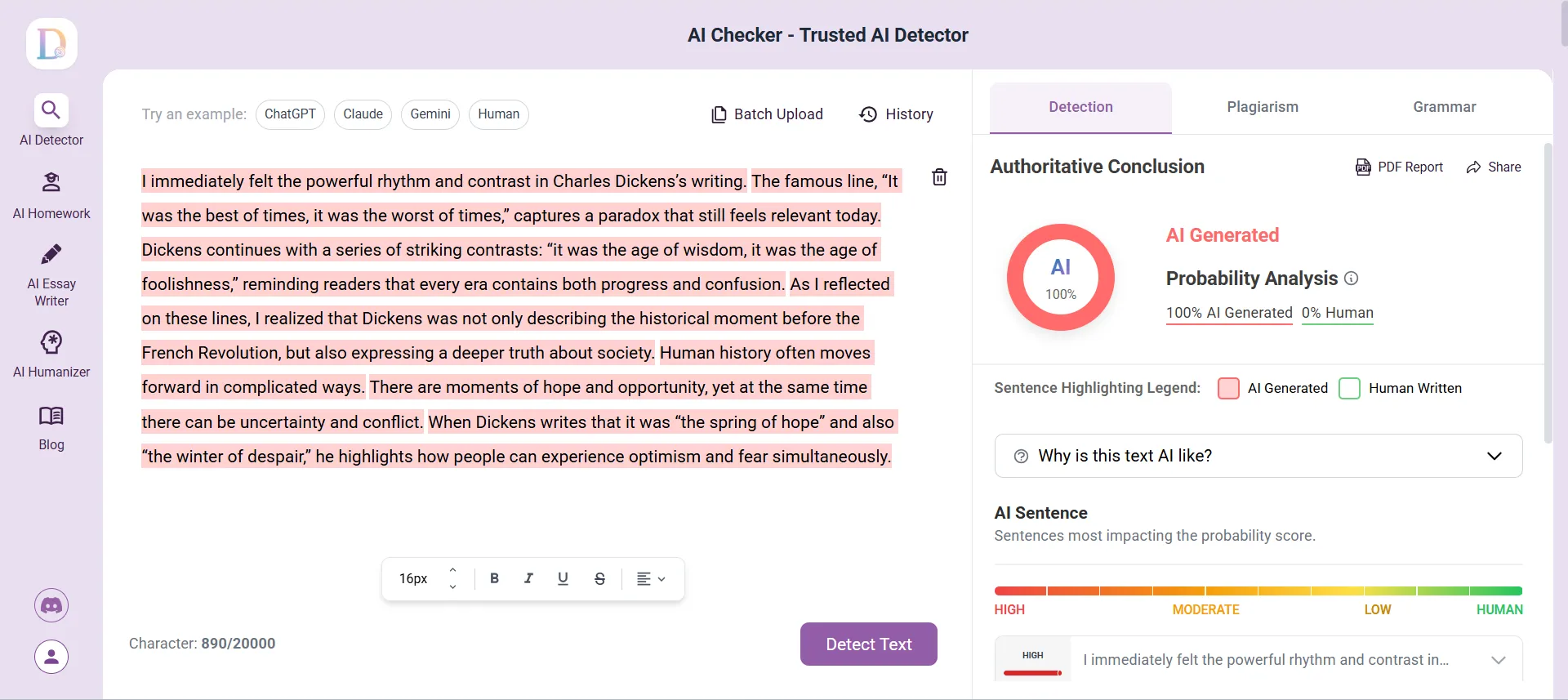
Dechecker isn’t just another AI detector—it’s an all-in-one content verification and optimization tool. Whether you’re a student checking essays, a blogger auditing posts, or an agency managing multiple clients, Dechecker gives you high accuracy, batch detection, history tracking, and rewriting capabilities.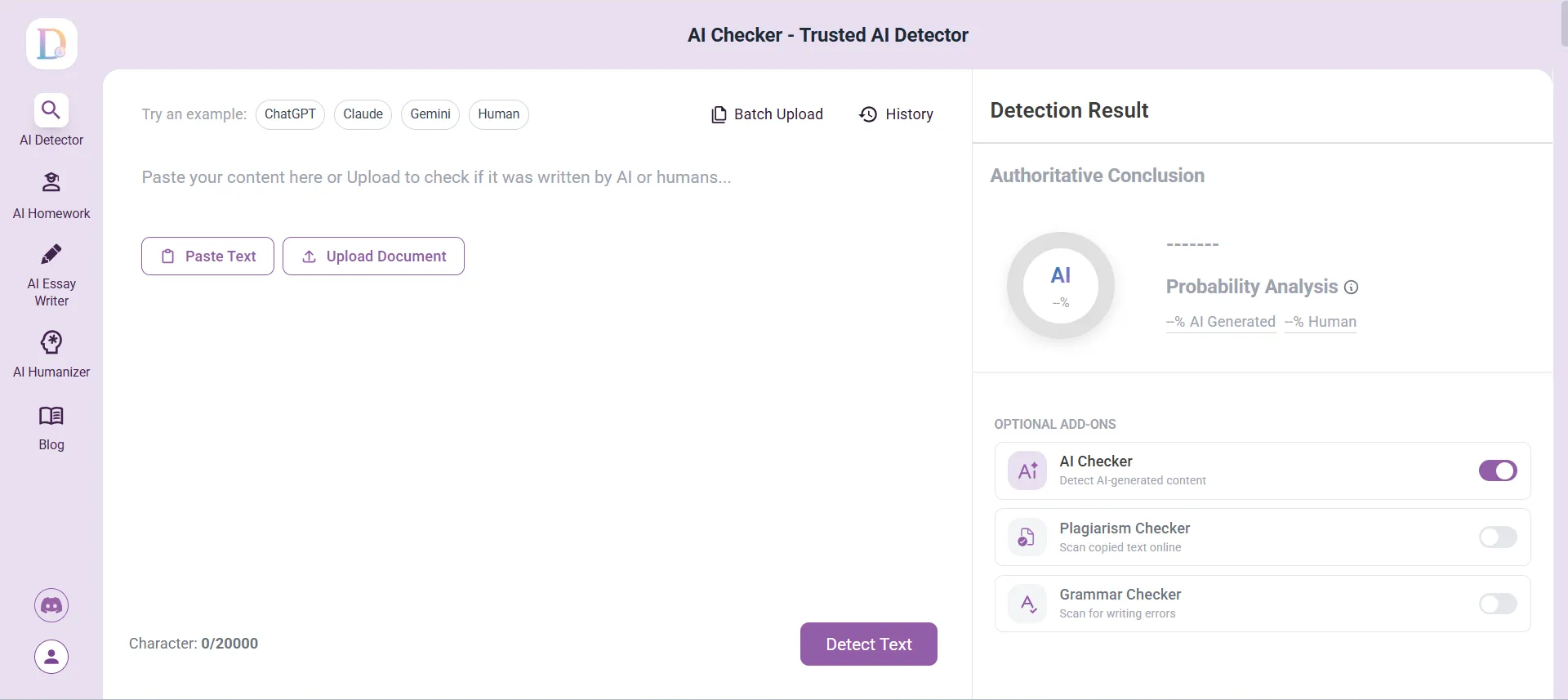
- Purpose: Detect AI-generated text, optimize content, manage workflow
- Target Users: Students, content creators, writers, agencies, academic teams
- Advanced language pattern analysis distinguishes AI-generated content
- Probability scoring identifies likelihood of AI authorship
- Continuous updates keep detection aligned with new AI models
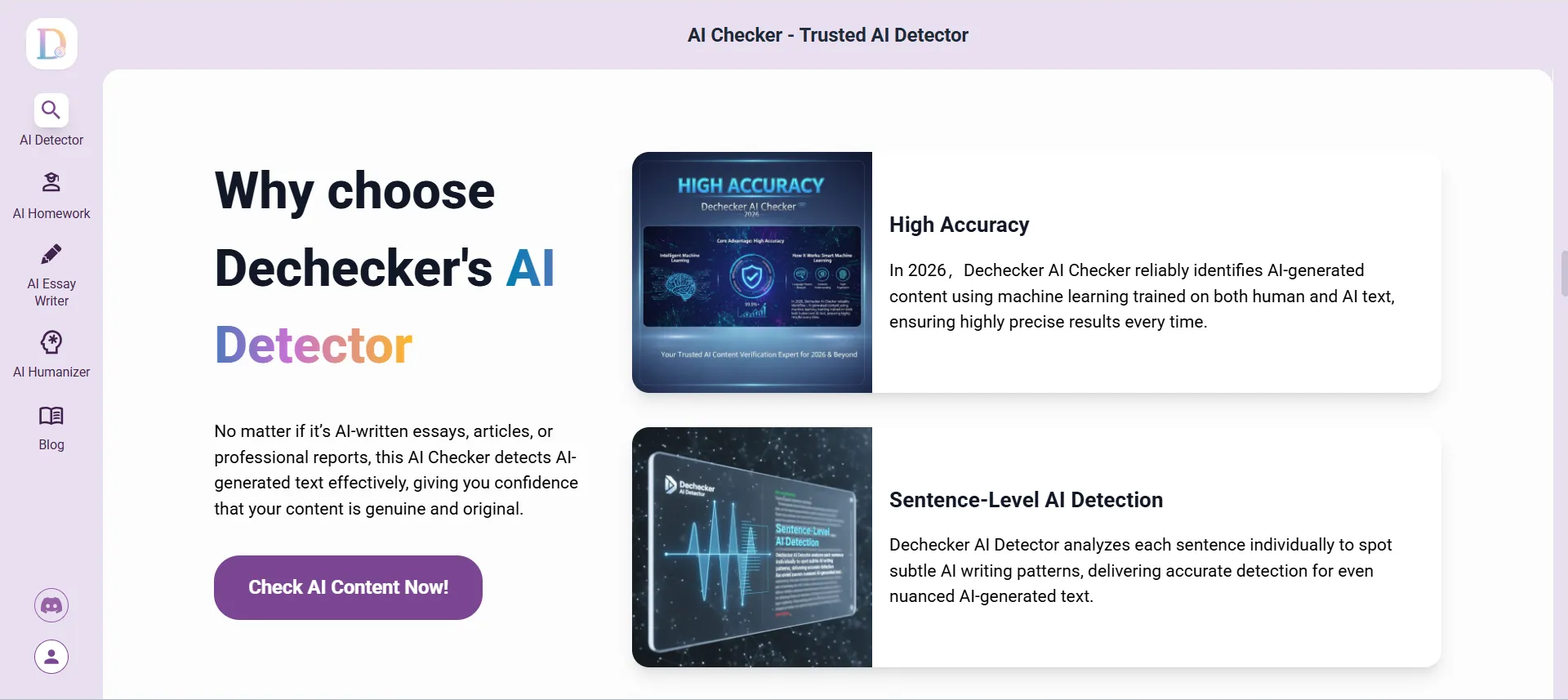
- High AI detector Accuracy: Reliable across essays, blogs, social media, and code. This ensures that both professional and academic content is accurately identified, reducing the risk of false positives or missed AI-generated text.
- History Tracking: View past detection results for accountability. This is useful for tracking multiple submissions over time, managing revisions, and maintaining records for academic or professional purposes.
- Batch File Detection: Process multiple files in one go. This feature saves time for students, writers, or teams handling large amounts of content, eliminating the need to check each document individually.
- Direct Rewriting: Correct and rephrase content immediately after detection. This allows users to improve readability, reduce AI detectability, or adjust tone without switching tools.
- One-Click Combined Check: AI detection + plagiarism + grammar check simultaneously. This all-in-one approach streamlines content verification and editing, making workflow more efficient and reducing the risk of errors.
- Advantages:
- All-in-one tool: Combines AI detection, plagiarism checking, and grammar correction in one platform, simplifying content management for professionals and students.
- Free: No hidden fees or paid tiers for essential features, making it accessible to everyone.
- Versatile: Supports multiple content types including academic essays, blogs, social media posts, and code, making it suitable for diverse use cases.
- Workflow efficiency: Features like batch detection, history tracking, and direct rewriting save users time and effort.
- Disadvantages:
- Edge-case inaccuracies possible: While detection is generally high, highly edited or hybrid human-AI content may occasionally produce false positives or negatives.
- Evolving AI models: New AI writing tools can temporarily reduce detection accuracy until updates are applied.
- Best Use Cases:
- Academic content verification: Ideal for students and educators checking assignments, essays, and research papers.
- SEO and blog content creation: Helps writers ensure authenticity and optimize content for search engines.
- Social media content checking: Ensures posts are original and suitable for professional or brand purposes.
- Professional writing workflow: Useful for agencies, content teams, or freelancers managing multiple clients and projects.
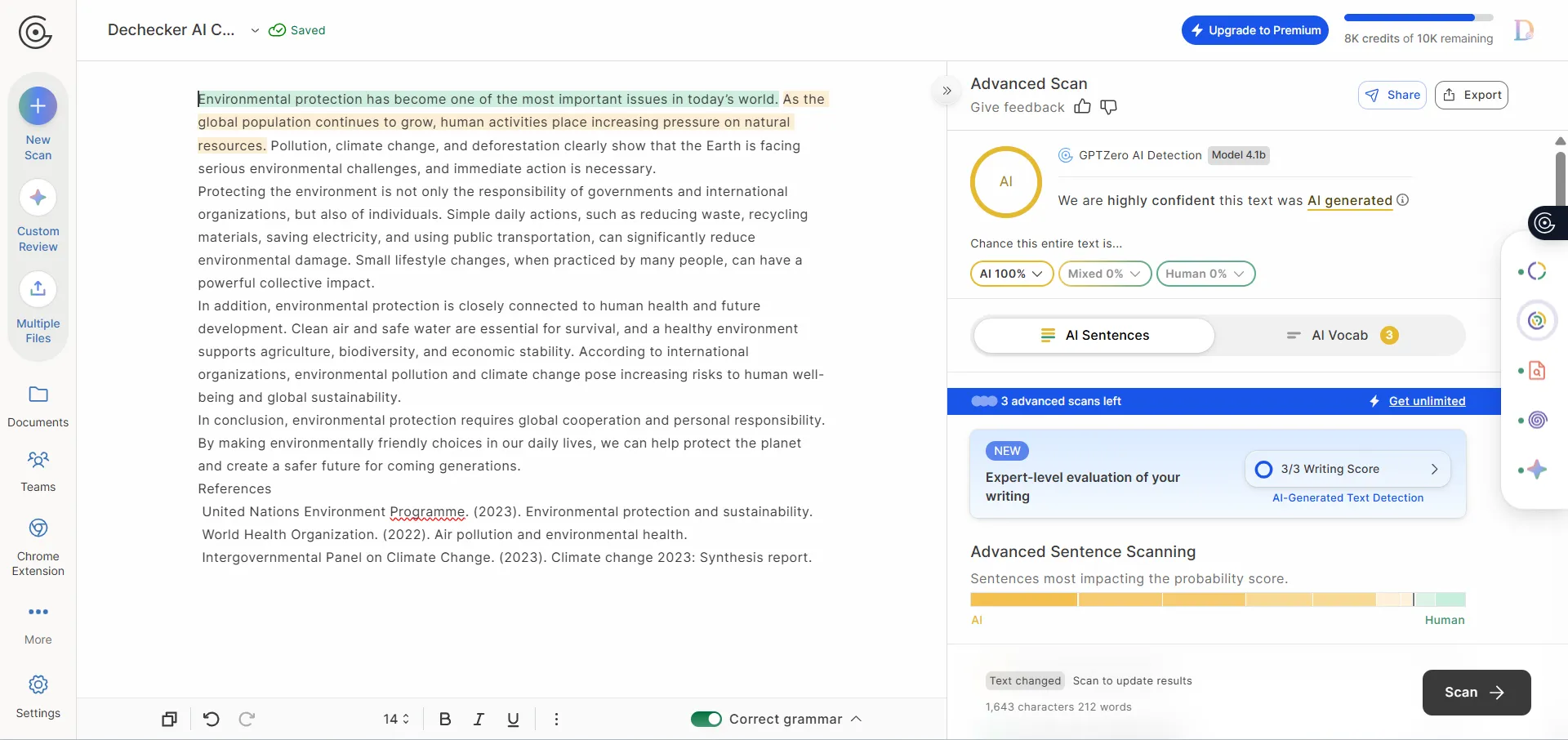
GPTZero is a focused AI detection tool primarily designed for academic use. If your main concern is verifying essays, assignments, or research papers, GPTZero provides reliable results through its sentence-level analysis.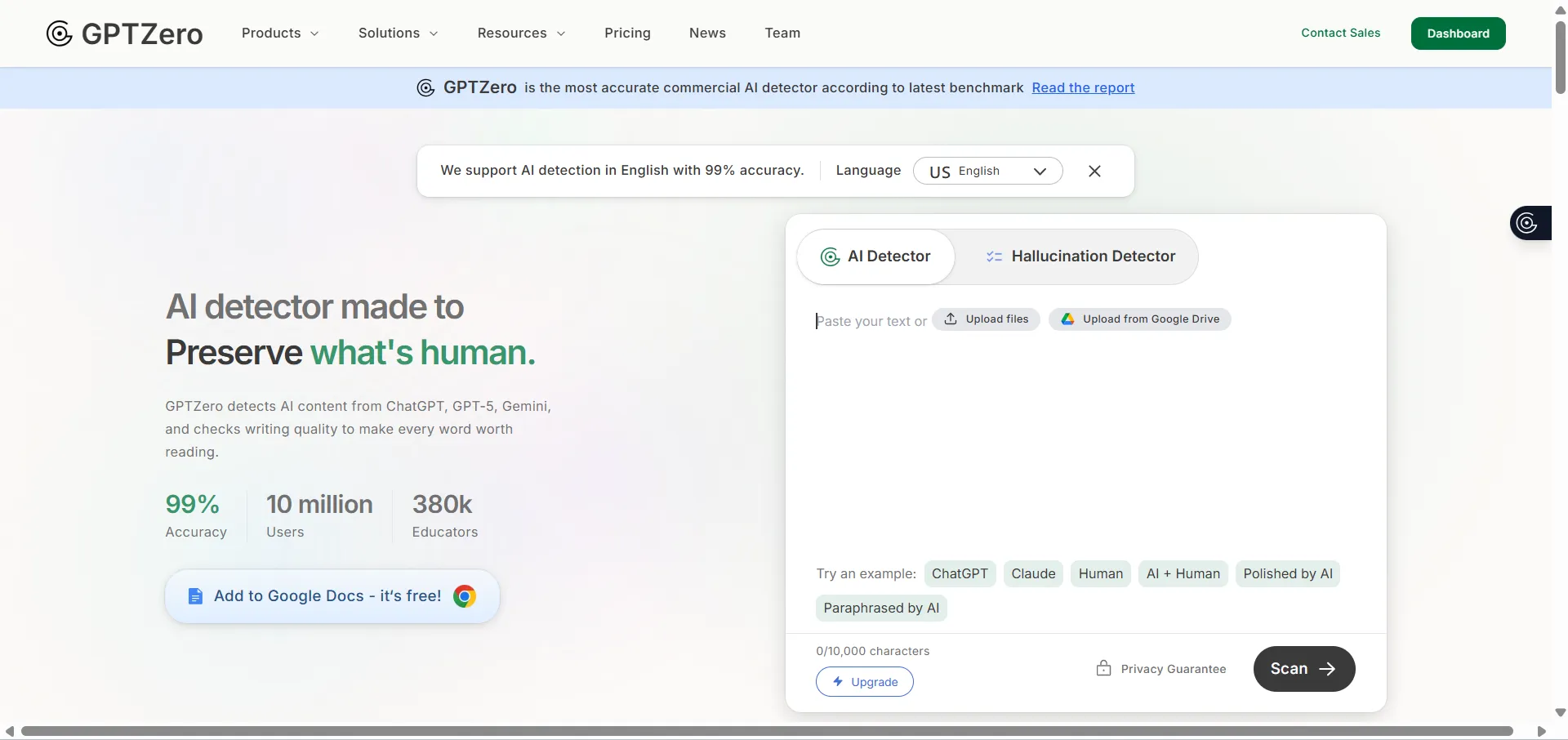
- Academic-oriented AI detector, optimized for essays and research papers.
- Target Users: Students, educators, and academic institutions who need focused AI detection.
- Simple, detection-only interface makes it easy for quick checks without additional workflow features.
- Uses perplexity and burstiness metrics to detect AI-generated writing. These metrics help identify text patterns that are typically produced by AI rather than humans.
- Highlights specific AI-generated sections within a text, allowing users to see exactly where AI influence occurs.
- Designed primarily for structured academic content, so it may be less effective on informal or edited content like blogs or social media posts.
- Sentence-Level Detection: Analyzes text sentence by sentence to provide detailed AI likelihood scores. This allows for precise identification of AI-generated passages.
- Academic Content Focus: Optimized for essays, assignments, and research papers, ensuring reliable detection in education scenarios.
- Simple Interface: Quick and easy to use for users who only need AI detection without extra workflow tools.
- Advantages:
- Strong academic accuracy: Highly reliable for structured essays and assignments, trusted by educators.
- Sentence-level analysis: Highlights specific sections likely generated by AI, making it easy to address problematic passages.
- Easy to use: Minimal learning curve, designed for quick, straightforward detection.
- Disadvantages:
- Limited workflow features: No batch detection, rewriting, or combined checks like plagiarism or grammar.
- Content type limitations: Less effective for blogs, social media posts, or creative writing outside academic settings.
- Paid tiers for higher volume: Free plan has limited daily checks, and heavy users may need to upgrade.
- Best Use Cases:
- Academic essays and assignments: Perfect for students submitting work or teachers grading papers.
- Academic integrity checks: Ensures compliance with anti-plagiarism and AI usage policies.
- Quick AI verification: Ideal for fast, focused checks without needing extra features.
Accuracy is one of the most important criteria when evaluating any AI detector. Both Dechecker and GPTZero deliver strong performance, but their strengths differ depending on content type and usage scenario. Independent benchmarks and industry tests provide useful context for understanding how each tool performs in real settings.
- Dechecker: In industry benchmark testing, Dechecker’s detection engine achieves an overall accuracy of about 96.2%, with a low false positive rate of roughly 1.8%, indicating strong capabilities in distinguishing AI‑generated text from human writing across various domains and AI models. It demonstrates high recall across content from modern generators like GPT‑4o, Claude, Gemini, and more.
- GPTZero: GPTZero has been shown in independent evaluations to achieve overall accuracy rates above 99% on controlled AI‑generated essay datasets, with very low false positives (~0.3%), and successfully detects the vast majority of AI‑generated text from models like GPT‑3.5 and GPT‑4. These results reflect AI detector strength in structured academic content where statistical patterns are clearer.
- Both tools can occasionally produce false positives or false negatives, especially when content has been extensively edited or blended with human writing. Real‑world text rarely remains purely raw AI output, and detection becomes more challenging in those hybrid cases.
- Dechecker evaluates a broader set of linguistic features and patterns, which can improve consistency across diverse content types such as blogs, social posts, and technical documents. Its benchmark results show strong recall and precision even across multiple languages and AI models.
- GPTZero focuses on metrics like perplexity and burstiness optimized for academic styles, making it highly reliable for essays and research papers but less flexible for highly informal or creative text where such patterns are weaker.
- Running the same content through both tools often yields differences in AI likelihood scores. Dechecker tends to provide nuanced results across varied content, while GPTZero produces clear academic‑focused detection.
- Even top detectors show reduced accuracy when AI‑generated text is paraphrased or hybridized with human writing, which emphasizes that no tool is infallible and results should be considered as probabilistic indicators rather than definitive proof.
- Many users and researchers recommend using multiple detectors or combining AI detection with manual review to increase confidence, especially in academic or professional contexts where accuracy is critical.
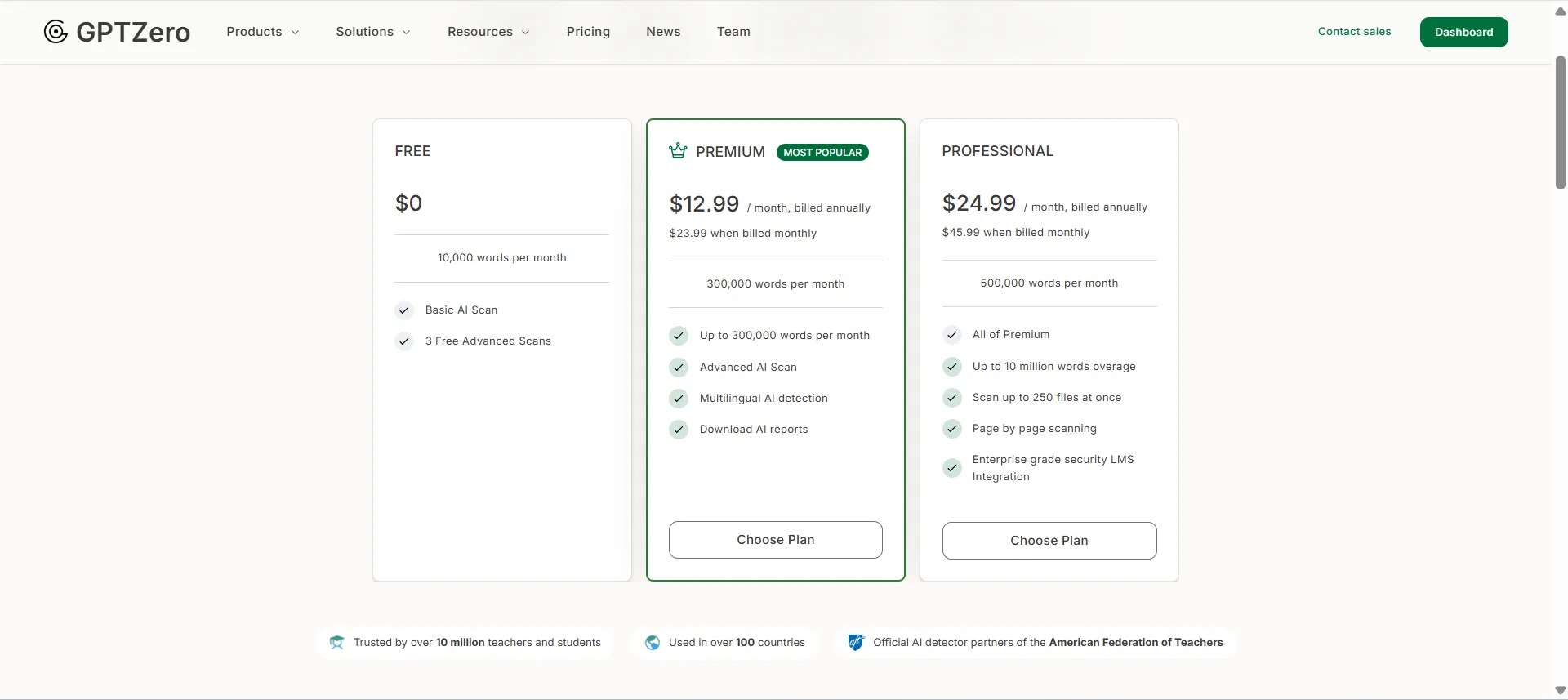
Pricing is an important factor when choosing an ai detector, especially if you plan to use it frequently or as part of a workflow. GPTZero and Dechecker have very different pricing models that reflect their features and target users.
GPTZero offers a tiered pricing model with both free and paid options depending on how much usage and additional features you need. The free tier allows basic usage, while paid plans expand capacity and tools:
- Free Plan: $0/month with limited scans and basic features, suitable for occasional checks.
- Pro/Subscription Plans: Around $19.9/month for unlimited AI detection, advanced analytics, detailed reports, and priority support.
- Lifetime Plan: One‑time payment of $299 gives lifetime access to pro features without recurring fees.
These paid tiers unlock greater usage, more detailed analytics, and additional tools, making GPTZero suitable for educators, publishers, and professionals who need regular, in‑depth detection and analysis.
Dechecker operates on a freemium model with full free access to its core features. According to official information, Dechecker is completely free to use with no registration required, allowing users to run full ai detection, rewrites, batch file processing, and history tracking at no cost.
The free and accessible model makes Dechecker a compelling choice for students, content creators, and teams who want powerful capabilities without subscription barriers.
- Dechecker: As a fully free AI detector tool with no paywalls for essential functions like detection, rewriting, batch checks, and combined AI/plagiarism/grammar checks, Dechecker provides exceptional value for most users—especially students, content creators, and small teams.
- GPTZero: Offers structured paid tiers that add advanced analytics and scalability. While effective and feature‑rich, GPTZero may be more suitable for heavy users requiring dedicated academic analytics or institutional use.
Selecting the right AI detector depends on the type of content you create, your workflow, and your user role. Here’s a breakdown based on common scenarios:
- Best AI detector: Dechecker or GPTZero
- Why: For students submitting essays, assignments, or research papers, Dechecker offers high detection accuracy, batch processing, history tracking, and rewriting features—helpful for both verification and improvement. GPTZero is effective for focused academic detection and provides simple, essay-specific results. Students can choose based on whether they need workflow features (Dechecker) or a quick, focused check (GPTZero).
- Best Tool: Dechecker or GPTZero
- Why: Teachers can use Dechecker for batch evaluation, tracking submissions, and verifying content across multiple assignments. GPTZero is convenient for fast, single-assignment checks or highlighting suspicious sections in essays. Combining both tools can increase confidence in detection results.

- Best Tool: Dechecker
- Why: For blogs, social media posts, and long-form content, Dechecker handles diverse content types, with added features like rewriting and combined grammar/plagiarism checks. GPTZero is less suitable here, as it primarily targets structured academic text.
- Best Tool: Dechecker
- Why: Teams managing multiple clients or large-scale content benefit from Dechecker’s batch detection, one-click combined checks, and history tracking. GPTZero lacks these workflow features, making Dechecker more efficient in professional environments.
- Best Tool: Dechecker
- Why: Freelancers and professional writers can rely on Dechecker to ensure content originality across multiple platforms, optimize writing, and maintain workflow efficiency. GPTZero is less versatile for these scenarios.
Summary:
- Dechecker is ideal when workflow, rewriting, and multi-content handling matter, especially for students, agencies, and professional writers.
- GPTZero is a strong option for quick, focused academic checks and essay-only verification.
- In academic contexts, combining both tools can provide maximum confidence and coverage.

AI detection is no longer optional—it’s essential in today’s content-driven world. While GPTZero is reliable for academic content, Dechecker’s combination of high accuracy, batch detection, rewriting, and one-click combined checks makes it the smarter choice for students, writers, marketers, and teams.
GPTZero is still a strong tool for academic-focused scenarios, but for anyone managing multiple content types or needing more than detection, Dechecker clearly offers the better overall experience.
Dechecker excels with diverse content types, including essays, blogs, social media posts, and code, while GPTZero is highly accurate on structured academic essays. For most users, Dechecker provides a more versatile detection solution across multiple scenarios.
No AI detector is perfect. Content heavily edited by humans, hybrid human-AI text, or newly released AI models can affect results. Using multiple tools or manual review alongside AI detection is recommended for critical work.
Yes. All features, including batch detection, rewriting, and combined checks (AI + plagiarism + grammar), are free. This makes it highly accessible for students, content creators, and teams without worrying about subscription fees.
Dechecker is ideal for students because it not only checks academic content for AI but also allows rewriting and workflow tracking. GPTZero works well for essay-only detection, especially if you only need simple academic verification.
Yes. Cross-checking results between tools like Dechecker and GPTZero can improve confidence, especially for academic submissions or professional content. Using multiple detectors helps reduce false positives and ensures more reliable verification.